A Level Economics (9708)•9708/12/O/N/18
A Level Economics (9708) — 9708/12/O/N/18, Question 21
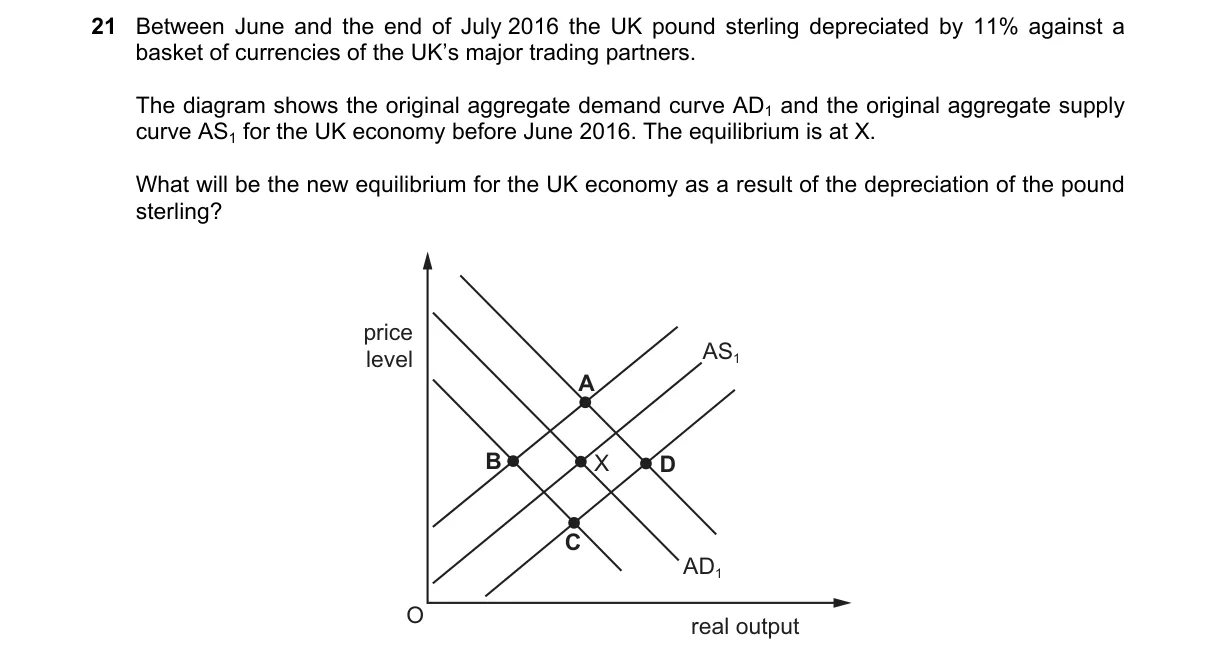
Between June and the end of July 2016 the UK pound sterling depreciated by 11% against a basket of currencies of the UK's major trading partners. The diagram shows the original aggregate demand curve AD, and the original aggregate supply curve AS, for the UK economy before June 2016. Equilibrium is X. What is the new equilibrium for the UK economy as a result of the depreciation of the pound sterling?
Answer choices
- AOption A
- BOption B
- COption C
- DOption D
Explanation
Currency Depreciation Shifts Aggregate Demand Rightward
Steps:
- Depreciation lowers the pound's value, making UK exports cheaper for foreign buyers.
- Export demand rises, increasing net exports (NX = exports - imports).
- Imports become more expensive, reducing import volumes and further boosting NX.
- Higher NX shifts AD right, raising equilibrium output and price level.
Why A is correct:
- A shows the new intersection of shifted-right AD and original AS, reflecting higher Y and P per the AD-AS model where NX is a component of AD (AD = C + I + G + NX).
Why the others are wrong:
- B: Indicates leftward AD shift, which would occur from appreciation, not depreciation.
- C: Suggests AS shift, but depreciation primarily affects AD via trade, not production costs.
- D: Implies no change or lower equilibrium, ignoring the expansionary effect on demand.
Final answer: A
Topic: Aggregate Demand and Aggregate Supply analysis
Practice more A Level Economics (9708) questions on mMCQ.me