A Level Economics (9708)•9708/11/O/N/18
A Level Economics (9708) — 9708/11/O/N/18, Question 16
The diagram shows equilibrium price, P, and quantity bought and sold, Q, in a market before a subsidy is granted. What represents the producer incidence (benefit) after the subsidy is granted and what is government expenditure on the subsidy?
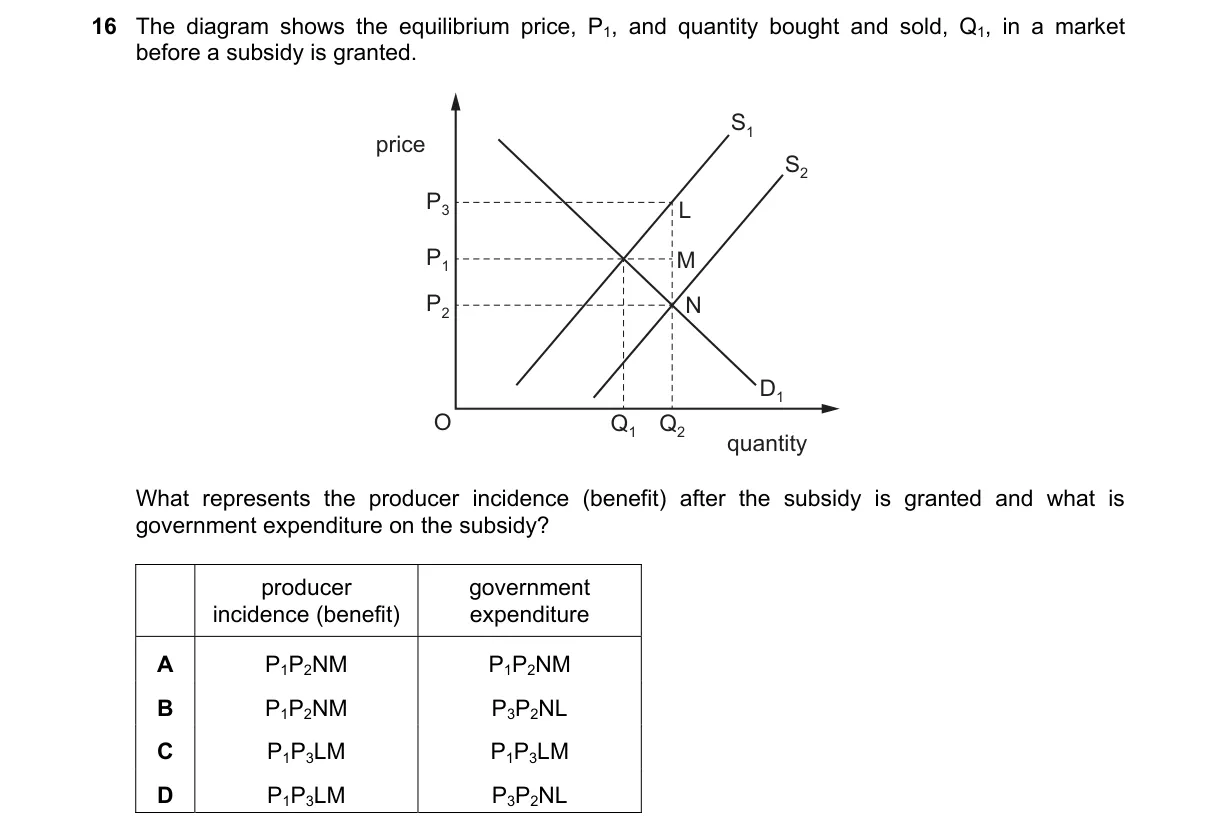
Answer choices
- AP.P.NM, P.P.NL
- BP.P.LM, P.P.LN
- CP.P.LM, P.P.NL
- DP.P.LM, P.P.NL
Explanation
Subsidy Effects on Producer Benefit and Government Cost
Steps:
- Identify post-subsidy equilibrium: quantity rises to Q' (at M), consumer price falls to P_c (at L), producer price rises to P_p (at N).
- Calculate producer incidence: gain from higher price (P to P_p) over new quantity (0 to Q'), forming trapezoid P-P-L-M.
- Determine government expenditure: total subsidy cost as per-unit subsidy (P_p - P_c, or N to L) times Q', forming rectangle P-P-N-L.
- Match choices: producer benefit P-P-L-M, expenditure P-P-N-L.
Why D is correct:
- D assigns P-P-L-M to producer incidence (price gain × Q') and P-P-N-L to expenditure (subsidy rate × Q'), per standard incidence analysis.
Why the others are wrong:
- A: Mislabels producer benefit as smaller area P-P-N-M, understating gain.
- B: Wrongly pairs P-P-L-M with P-P-L-N, confusing expenditure with consumer side.
- C: Incorrectly uses P-P-N-L for expenditure but mismatches producer area.
Final answer: D
Topic: Methods and effects of government intervention in markets
Practice more A Level Economics (9708) questions on mMCQ.me