A Level Economics (9708)•9708/11/O/N/18
A Level Economics (9708) — 9708/11/O/N/18, Question 15
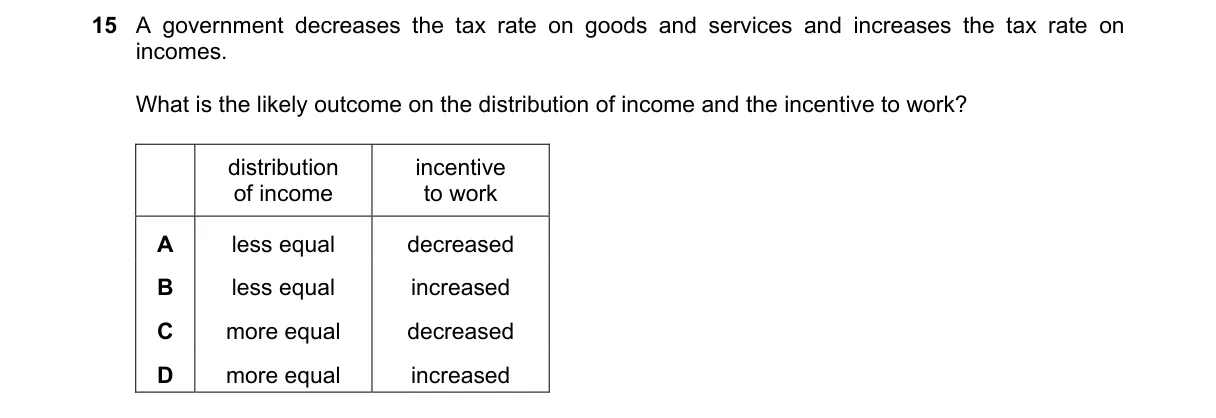
Government decreases the tax rate on goods and services and increases the tax on income. What is the likely outcome on the distribution of income and the incentive to work?
Answer choices
- Aless equal, decreased
- Bless equal, increased
- Cmore equal, decreased
- Dmore equal, increased
Explanation
Shifting Tax Burden from Regressive to Progressive
Steps:
- Sales taxes on goods/services are regressive, disproportionately burdening low-income earners; reducing them eases this burden.
- Income taxes are progressive, taxing higher earners more; increasing them shifts the load to the wealthy.
- This reallocation makes after-tax income distribution more equal by reducing inequality.
- Higher income taxes raise marginal rates on earnings, decreasing the incentive to work.
Why C is correct:
- Progressive taxation (higher rates on income) reduces income inequality per the ability-to-pay principle, while elevated marginal tax rates lower work incentives via substitution effect in labor supply theory.
Why the others are wrong:
- A: Distribution becomes more equal, not less, due to progressive shift.
- B: Work incentive decreases from higher income taxes, not increases.
- D: Work incentive decreases, not increases, despite equality gains.
Final answer: C
Topic: Equity and redistribution of income and wealth
Practice more A Level Economics (9708) questions on mMCQ.me