A Level Economics (9708)•9708/14/M/J/25
A Level Economics (9708) — 9708/14/M/J/25, Question 2
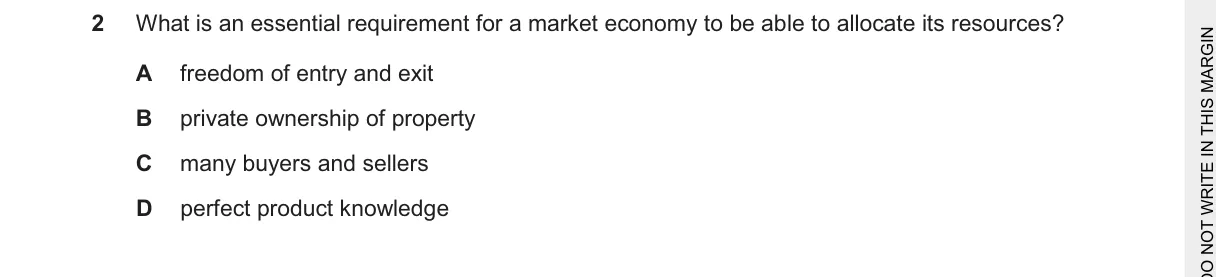
What is an essential requirement for a market economy to be able to allocate its resources?
Answer choices
- Afreedom of entry and exit
- Bprivate ownership of property
- Cmany buyers and sellers
- Dperfect product knowledge
Explanation
Private Property Rights as Market Foundation
Steps:
- Define market economy: System where resources allocate via supply-demand prices from voluntary exchanges.
- Identify core enabler: Private ownership allows individuals to control, trade, and respond to market signals.
- Link to allocation: Without ownership, no incentives for efficient production or consumption decisions.
- Confirm via economics: Property rights underpin Adam Smith's "invisible hand" for resource distribution.
Why the correct option is correct:
- Private ownership of property is essential per economic theory, as it creates enforceable rights for trading resources, enabling price mechanisms to guide allocation (e.g., Coase theorem on transaction costs).
Why the others are wrong:
- A: Freedom of entry/exit supports competition but assumes existing property rights.
- C: Many buyers/sellers define perfect competition, a model feature, not a foundational requirement.
- D: Perfect knowledge aids efficiency but is unrealistic and secondary to ownership.
Final answer: B
Topic: Resource allocation in different economic systems
Practice more A Level Economics (9708) questions on mMCQ.me