A Level Economics (9708)•9708/13/M/J/25
A Level Economics (9708) — 9708/13/M/J/25, Question 23
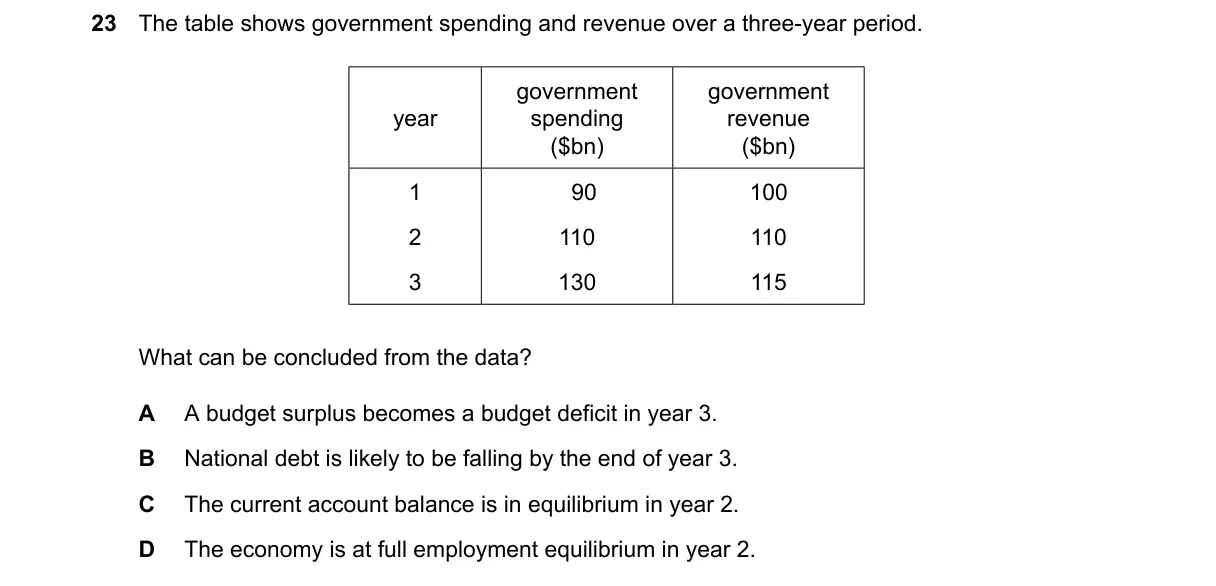
The table shows government spending and revenue over a three-year period.
| year | government spending | government revenue |
| 1 | 90bn | 100bn |
| 2 | 110 | 115 |
| 3 | 130 | 110 |
What can be concluded from the data?
Answer choices
- AA budget surplus becomes a budget deficit in year 3.
- BNational debt is likely to be falling by the end of year 2.
- CThe current account balance is in equilibrium in year 2.
- DThe economy is at full employment equilibrium in year 2.
Explanation
Budget balance shifts from surplus to deficit
Steps:
- Calculate budget balance for each year: surplus if revenue exceeds spending, deficit if spending exceeds revenue.
- Year 1: 100bn revenue - 90bn spending = 10bn surplus.
- Year 2: 115bn - 110bn = 5bn surplus.
- Year 3: 110bn - 130bn = 20bn deficit.
Why A is correct:
- Budget surplus occurs when revenue > spending; deficit when spending > revenue; data shows surpluses in years 1-2 turning to deficit in year 3.
Why the others are wrong:
- B: Debt reduction requires sustained surpluses and initial debt levels, but data alone does not confirm falling debt.
- C: Current account balance involves trade and net income, unrelated to government fiscal data.
- D: Full employment equilibrium concerns labor market conditions, not fiscal spending or revenue.
Final answer: A
Topic: Fiscal policy
Practice more A Level Economics (9708) questions on mMCQ.me