A Level Economics (9708)•9708/12/M/J/25
A Level Economics (9708) — 9708/12/M/J/25, Question 4
A country increases its spending on education and training. It pays for this by reducing unemployment benefit payments and increasing taxes on imports of machinery. What is the likely effect of these changes on human capital and physical capital?
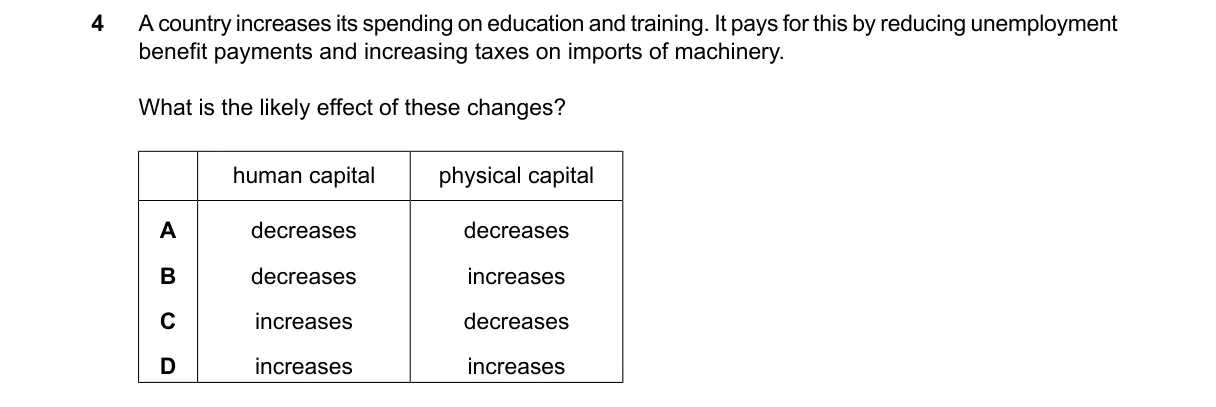
Answer choices
- Ahuman capital decreases, physical capital increases
- Bhuman capital decreases, physical capital decreases
- Chuman capital increases, physical capital decreases
- Dhuman capital increases, physical capital increases
Explanation
Fiscal Policy Effects on Capital Types
Steps:
- Increased education and training spending directly enhances skills and knowledge, raising human capital.
- Funding via reduced unemployment benefits reallocates resources without directly harming human capital.
- Higher taxes on machinery imports raise costs, discouraging investment in equipment and reducing physical capital accumulation.
- Net effect: human capital rises from education focus, physical capital falls from import barriers.
Why C is correct:
- Human capital, defined as workforce skills and productivity from education (per economic growth models like Solow), increases; physical capital, tangible assets like machinery, decreases due to import taxes limiting investment.
Why the others are wrong:
- A: Human capital rises, not decreases, from education spending.
- B: Human capital rises, not decreases.
- D: Physical capital decreases, not increases, from machinery import taxes.
Final answer: C
Topic: Supply-side policy
Practice more A Level Economics (9708) questions on mMCQ.me