A Level Economics (9708)•9708/12/M/J/25
A Level Economics (9708) — 9708/12/M/J/25, Question 22
Government increases direct taxation to reduce its budget deficit. How is this likely to affect the government’s ability to achieve its macroeconomic objectives?
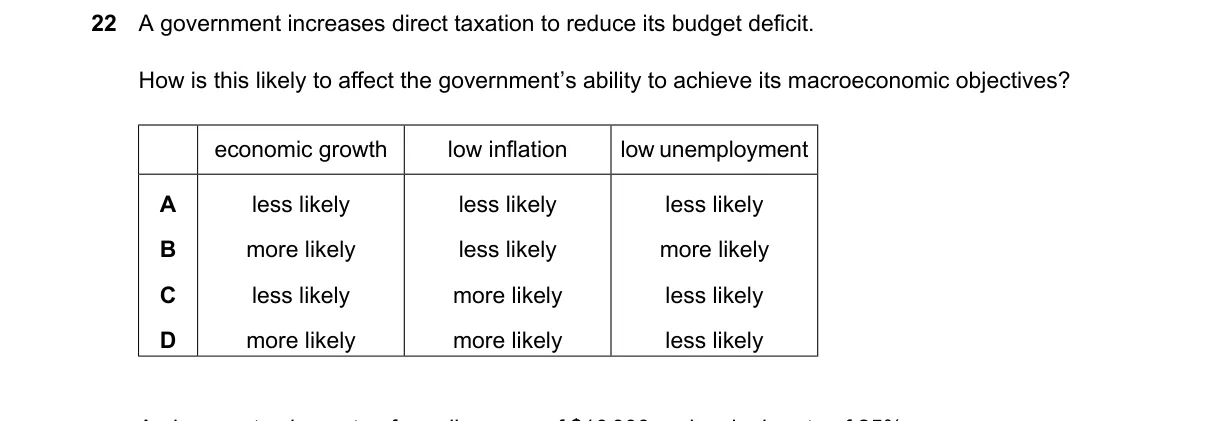
Answer choices
- Aless likely, less likely, less likely
- Bmore likely, less likely, more likely
- Cless likely, more likely, less likely
- Dmore likely, more likely, less likely
Explanation
Contractionary Fiscal Policy Effects
Steps:
- Increasing direct taxation reduces disposable income for households.
- Lower disposable income decreases consumption and aggregate demand (AD).
- Reduced AD slows economic growth and raises unemployment, hindering those objectives.
- Simultaneously, lower AD curbs demand-pull inflation, aiding price stability.
Why C is correct:
- C (less likely for growth, more likely for low inflation, less likely for low unemployment) aligns with AD shift leftward per Keynesian model.
Why the others are wrong:
- A ignores inflation control benefit from reduced AD.
- B wrongly suggests growth boost, opposite of contractionary policy.
- D incorrectly implies easier growth and inflation control simultaneously.
Final answer: C
Topic: Effectiveness of policy options to meet all macroeconomic objectives
Practice more A Level Economics (9708) questions on mMCQ.me