A Level Economics (9708)•9708/12/M/J/25
A Level Economics (9708) — 9708/12/M/J/25, Question 17
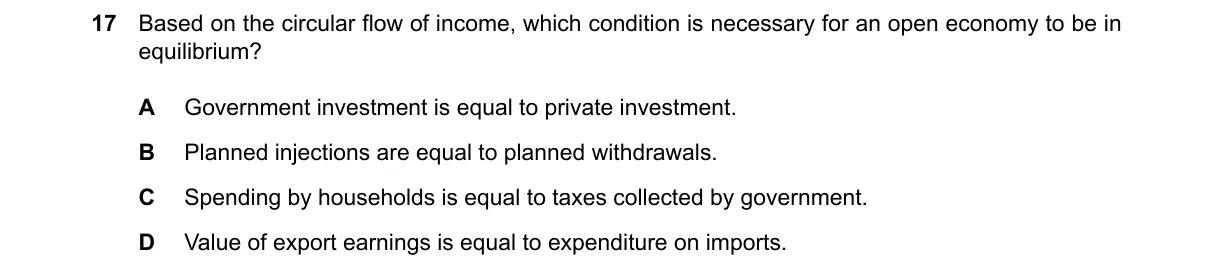
Based on the circular flow of income, which condition is necessary for an open economy to be in equilibrium?
Answer choices
- AGovernment investment is equal to private investment.
- BPlanned injections are equal to planned withdrawals.
- CSpending by households is equal to taxes collected by government.
- DValue of exports is equal to expenditure on imports.
Explanation
Equilibrium in Circular Flow Model
Steps:
- Recall the circular flow model: income flows between households and firms, with injections (investment, government spending, exports) adding to the flow and withdrawals (savings, taxes, imports) removing from it.
- In an open economy, equilibrium occurs when total planned injections equal total planned withdrawals, balancing the economy without unintended inventory changes.
- Analyze choices: A focuses only on investments, ignoring other flows; C limits to households and taxes; D equates only trade components.
- Confirm B matches the core condition for equilibrium in the model.
Why B is correct:
- Equilibrium requires planned injections (I + G + X) to equal planned withdrawals (S + T + M), ensuring aggregate demand equals aggregate supply per the circular flow identity.
Why the others are wrong:
- A: Ignores savings, taxes, imports, and exports; equilibrium involves all injections and withdrawals.
- C: Only partial withdrawal (taxes) versus household spending; misses full flow balance.
- D: Balances trade but neglects domestic injections like investment and government spending.
Final answer: B
Topic: The circular flow of income
Practice more A Level Economics (9708) questions on mMCQ.me