A Level Economics (9708)•9708/11/M/J/25
A Level Economics (9708) — 9708/11/M/J/25, Question 8
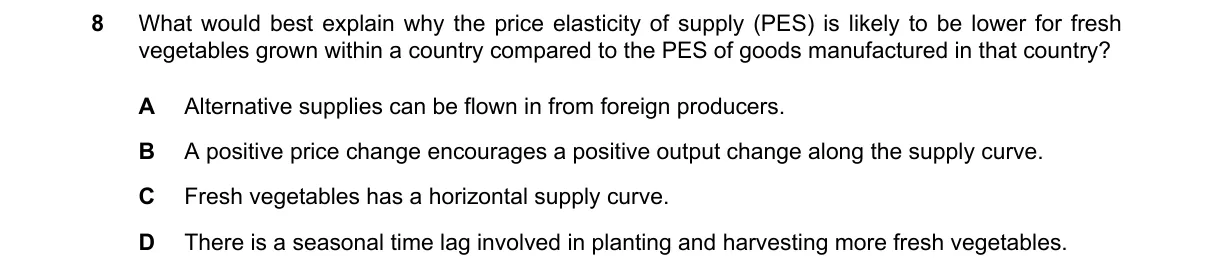
What would best explain why the price elasticity of supply (PES) is likely to be lower for fresh vegetables grown within a country compared to the PES of goods manufactured in that country?
Answer choices
- AAlternative supplies can be flown in from foreign producers.
- BA positive price change encourages a positive output change along the supply curve.
- CFresh vegetables have a horizontal supply curve.
- DThere is a seasonal time lag involved in planting and harvesting more fresh vegetables.
Explanation
Time Lags Reduce Supply Elasticity
Steps:
- Recall PES measures percentage change in quantity supplied divided by percentage change in price; higher PES means more responsive supply.
- Compare production processes: manufacturing allows quick adjustments via labor or machinery, raising PES.
- For fresh vegetables, supply depends on agricultural cycles, limiting short-run responsiveness.
- Identify factor causing lower PES for vegetables: delays in planting and harvesting prevent rapid output increases.
Why D is correct:
- PES decreases with longer time lags in production (per elasticity formula, responsiveness falls when supply adjustments are time-constrained by biological/seasonal factors).
Why the others are wrong:
- A: Importing alternatives would increase overall PES, not explain lower domestic vegetable PES.
- B: This describes the upward-sloping supply curve, which applies equally to both goods and doesn't differentiate elasticity.
- C: A horizontal supply curve implies perfectly elastic supply (infinite PES), contradicting lower elasticity for vegetables.
Final answer: D
Topic: Price elasticity of supply
Practice more A Level Economics (9708) questions on mMCQ.me