A Level Economics (9708)•9708/11/M/J/25
A Level Economics (9708) — 9708/11/M/J/25, Question 4
In 2020, there was a worldwide pandemic. High-income countries quickly developed a vaccine. Low-income countries built high-tech factories to manufacture large quantities of the vaccine for export. What explains this international division of labour?
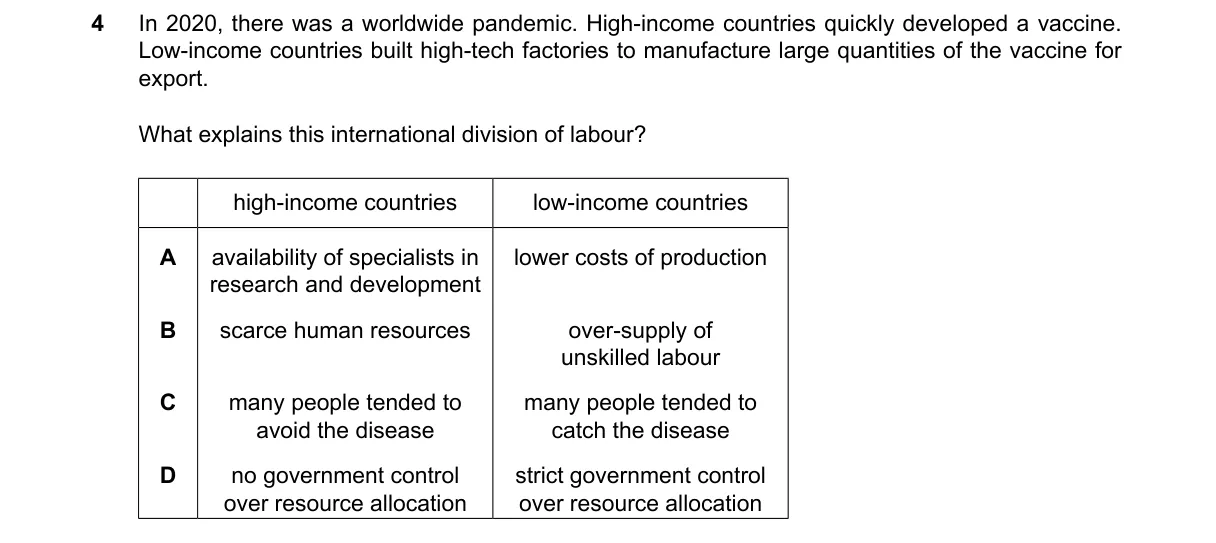
Answer choices
- Aavailability of specialists / low-cost production
- Bresearch and development / over-supply of unskilled labour
- Cmany people tended to avoid the disease
- Dno government control over resource allocation / strict government control over resource allocation
Explanation
Comparative Advantage in Vaccine Production
Steps:
- Identify the scenario: High-income countries develop vaccines (innovation stage), low-income countries manufacture for export (production stage).
- Recall international division of labor: Countries specialize based on comparative advantages like skills and costs.
- Match to choices: Option A aligns with high-income expertise in R&D and low-income cost efficiencies.
- Eliminate irrelevant options: C and D don't explain specialization; B mismatches labor types.
Why A is correct:
- Reflects comparative advantage theory, where high-income countries leverage specialist availability for R&D, while low-income countries use low-cost production for manufacturing efficiency.
Why the others are wrong:
- B: Low-income countries built high-tech factories, requiring skilled labor, not unskilled over-supply.
- C: Disease avoidance doesn't explain production specialization or export focus.
- D: Governments controlled vaccine allocation globally, contradicting the division of labor.
Final answer: A
Topic: The reasons for international trade
Practice more A Level Economics (9708) questions on mMCQ.me