A Level Economics (9708)•9708/11/M/J/25
A Level Economics (9708) — 9708/11/M/J/25, Question 29
Primary income and secondary income are components of the current account of the balance of payments. Which option correctly identifies an example of primary income and secondary income?
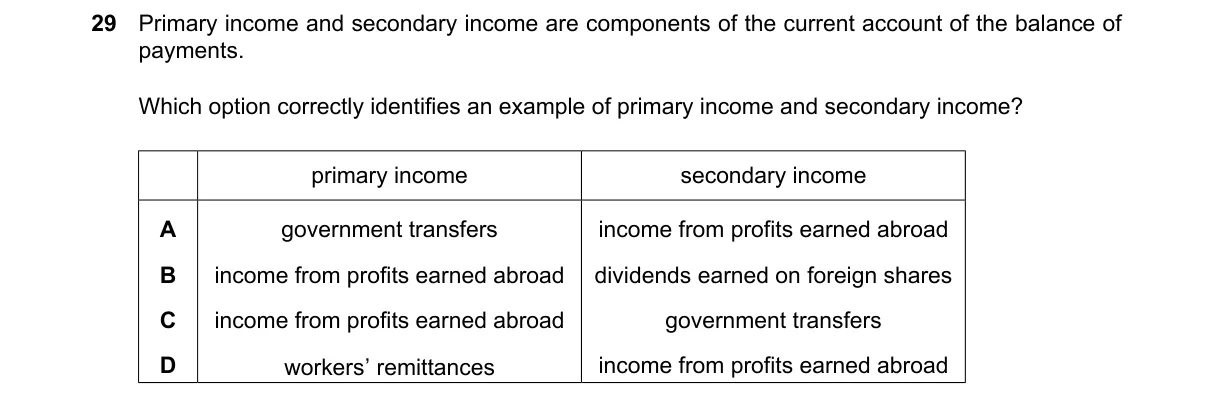
Answer choices
- APrimary income: government transfers; Secondary income: income from profits earned abroad
- BPrimary income: income from profits earned abroad; Secondary income: dividends earned on foreign shares
- CPrimary income: income from profits earned abroad; Secondary income: government transfers
- DPrimary income: workers' remittances; Secondary income: income from profits earned abroad
Explanation
Classifying Primary vs. Secondary Income in Current Account
Steps:
- Define primary income as earnings from investments, such as profits, dividends, and interest from abroad.
- Define secondary income as unilateral transfers without direct compensation, like government aid and workers' remittances.
- Match examples to definitions: profits earned abroad fit primary; government transfers fit secondary.
- Select the option aligning profits with primary and transfers with secondary.
Why C is correct:
- Primary income includes investment returns like profits earned abroad (IMF Balance of Payments Manual, Section 6); secondary income covers transfers like government aid (Section 7).
Why the others are wrong:
- A: Reverses categories; government transfers are secondary, not primary.
- B: Both profits and dividends are primary investment income.
- D: Workers' remittances are secondary transfers, not primary.
Final answer: C
Topic: Current account of the balance of payments
Practice more A Level Economics (9708) questions on mMCQ.me