A Level Economics (9708)•9708/11/M/J/25
A Level Economics (9708) — 9708/11/M/J/25, Question 12
Too much sugar causes an increase in a consumer's weight. Government has introduced a sugar tax on the consumption of soft drinks that have high sugar content. How might this policy help to reduce the number of overweight people?
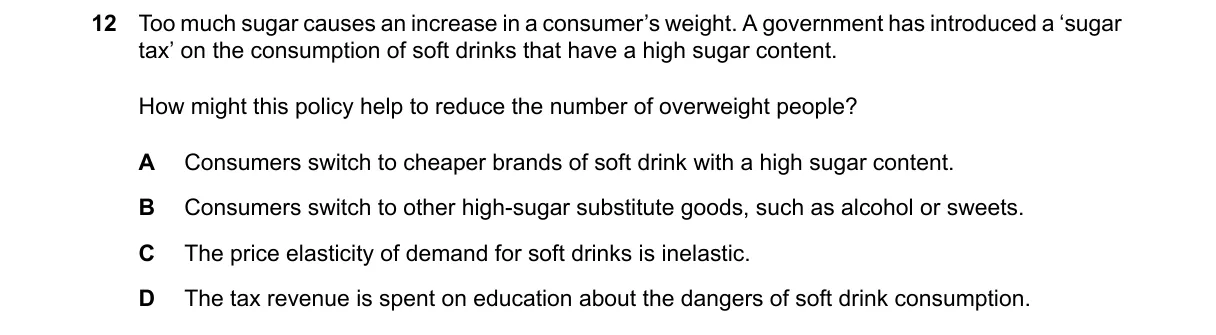
Answer choices
- AConsumers switch to cheaper brands of soft drink with high sugar content.
- BConsumers switch to other high-sugar substitute goods, such as alcohol or sweets.
- CThe price elasticity of demand for sugar is inelastic.
- DThe tax revenue is spent on education about the dangers of soft drink consumption.
Explanation
Tax revenue funds awareness to curb sugar intake
Steps:
- Sugar tax raises soft drink prices, aiming to lower consumption and weight gain.
- Revenue from the tax provides government funds for targeted initiatives.
- Education campaigns inform consumers about health risks of high-sugar drinks.
- Informed consumers reduce soft drink intake, decreasing overweight prevalence.
Why D is correct:
- Tax revenue allocation to education leverages public finance principles, where funds from a sin tax directly address the externality of obesity by changing consumer behavior through awareness.
Why the others are wrong:
- A: Switching to cheaper high-sugar brands maintains consumption levels, not reducing weight.
- B: Substituting other high-sugar goods keeps overall sugar intake high, failing to address obesity.
- C: Inelastic demand means quantity demanded barely changes with price, so tax wouldn't effectively cut consumption.
Final answer: D
Topic: Methods and effects of government intervention in markets
Practice more A Level Economics (9708) questions on mMCQ.me