A Level Economics (9708)•9708/13/M/J/24
A Level Economics (9708) — 9708/13/M/J/24, Question 29
Economists suggest multilateral trade between many countries is preferable to bilateral trade between two countries. Why is this?
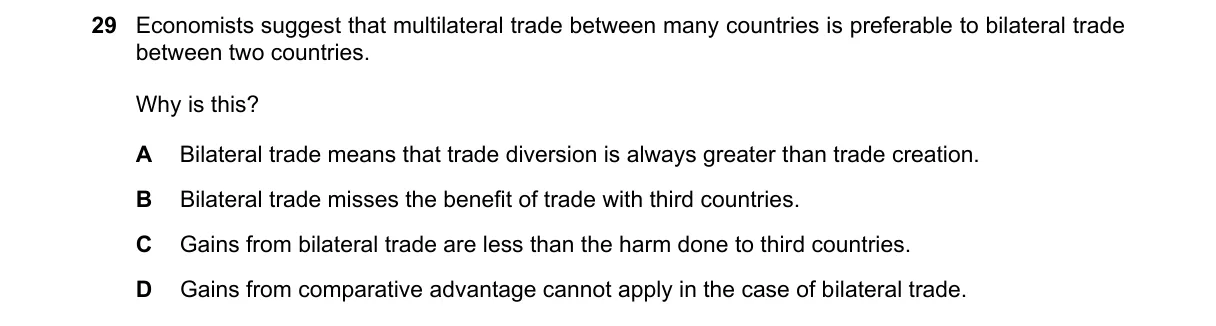
Answer choices
- ABilateral trade means that trade diversion is always greater than trade creation.
- BBilateral trade misses the benefit of trade with third countries.
- CGains from bilateral trade are less than harm done to third countries.
- DGains from comparative advantage cannot apply in the case of bilateral trade.
Explanation
Broader Benefits of Multilateral Trade
Steps:
- Identify the core advantage of multilateral over bilateral trade: it involves more countries, enabling wider market access.
- Recall trade theory: multilateral agreements reduce barriers globally, maximizing efficiency through specialization.
- Compare impacts: bilateral deals limit partners, potentially excluding optimal trade routes with others.
- Conclude preference: multilateral captures full gains from comparative advantage across all nations.
Why B is correct:
- In trade theory, multilateralism leverages comparative advantage with multiple partners, as defined by Ricardo's model, allowing countries to trade with the most efficient third parties for overall welfare gains.
Why the others are wrong:
- A: Trade diversion isn't always greater in bilateral trade; it depends on tariff levels, not inherently.
- C: Bilateral gains aren't necessarily less than harm to third countries; net effects vary by agreement design.
- D: Comparative advantage applies equally to bilateral trade; the issue is scope, not applicability.
Final answer: B
Topic: The reasons for international trade
Practice more A Level Economics (9708) questions on mMCQ.me