A Level Economics (9708)•9708/13/M/J/24
A Level Economics (9708) — 9708/13/M/J/24, Question 13
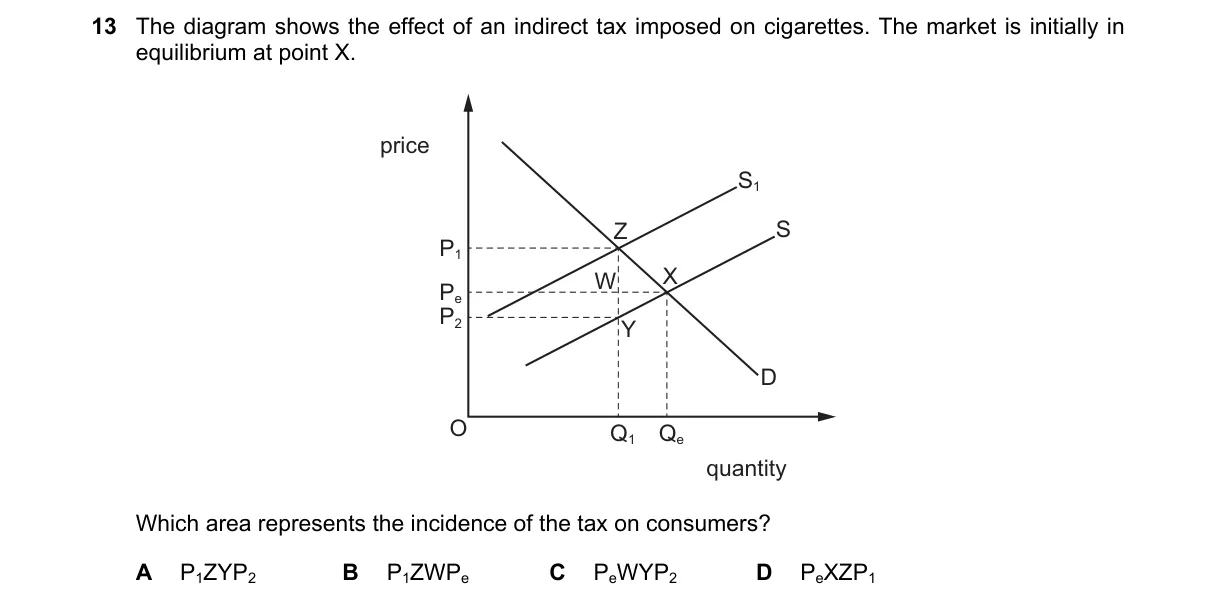
The diagram shows the effect of an indirect tax imposed on cigarettes. The market is initially in equilibrium at point X. Which area represents the incidence of the tax on consumers?
Answer choices
- APZ
- BP2W
- CP1WY
- DPXZ
Explanation
Consumer Tax Incidence in Market Diagram
Steps:
- Pre-tax equilibrium at X sets initial price and quantity.
- Tax shifts supply curve up; new equilibrium has higher consumer price (P1 or similar) and lower quantity.
- Consumer incidence is the price rise borne by buyers, forming a rectangular area between original and new consumer price, up to post-tax quantity.
- Match areas to diagram: P2W aligns with this price wedge for consumers.
Why B is correct:
- Tax incidence on consumers is defined as the increase in price paid by buyers (Pc - P0) times post-tax quantity, matching area P2W as the buyer burden rectangle.
Why the others are wrong:
- A. PZ: Represents producer surplus loss or unrelated segment.
- C. P1WY: Includes full tax revenue triangle, not just consumer share.
- D. PXZ: Covers deadweight loss or pre-tax area, ignoring incidence split.
Final answer: B
Topic: Methods and effects of government intervention in markets
Practice more A Level Economics (9708) questions on mMCQ.me