A Level Economics (9708)•9708/11/M/J/24
A Level Economics (9708) — 9708/11/M/J/24, Question 24
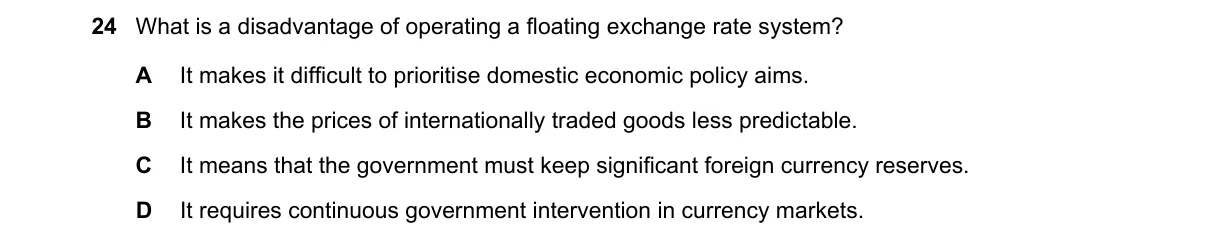
What is a disadvantage of operating a floating exchange rate system?
Answer choices
- AIt makes it difficult to prioritise domestic economic policy aims.
- BIt means prices of internationally traded goods less predictable.
- CIt means that the government must keep significant foreign currency reserves.
- DIt requires continuous government intervention in currency markets.
Explanation
Floating exchange rates lead to exchange rate volatility
Steps:
- Recall that floating exchange rates are determined by market supply and demand, without central bank intervention.
- Identify disadvantages: volatility can affect trade predictability, while advantages include policy flexibility.
- Evaluate options: A relates to fixed rates; B matches volatility issue; C and D describe fixed rate requirements.
- Confirm B as the core disadvantage for international trade.
Why B is correct:
- In floating systems, exchange rates fluctuate freely per market forces (supply/demand law), making prices of traded goods unpredictable and increasing business risk.
Why the others are wrong:
- A: Floating rates allow prioritizing domestic policies, as the exchange rate adjusts automatically to external shocks.
- C: Significant reserves are needed for fixed rates to defend the peg, not floating.
- D: Floating rates require minimal government intervention, unlike managed or fixed systems.
Final answer: B
Topic: Exchange rates
Practice more A Level Economics (9708) questions on mMCQ.me