A Level Economics (9708)•9708/11/M/J/24
A Level Economics (9708) — 9708/11/M/J/24, Question 16
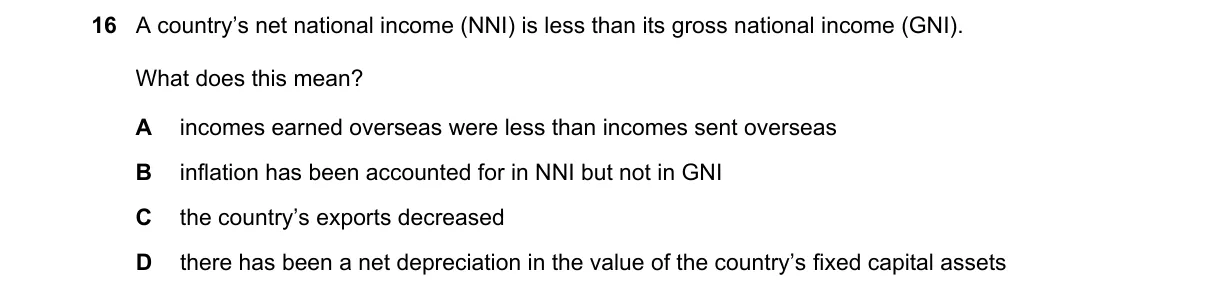
A country's net national income (NNI) is less than its gross national income (GNI). What does this mean?
Answer choices
- AIncomes earned overseas were less than incomes sent overseas
- BThe country's inflation decreased NNI but not GNI
- CThe country's exports accounted for NNI not GNI
- DThere has been a net depreciation in the value of the country's fixed capital assets
Explanation
NNI accounts for capital depreciation unlike GNI
Steps:
- GNI measures total income earned by residents, including abroad, before capital wear.
- NNI calculates sustainable income by subtracting depreciation from GNI.
- NNI < GNI shows depreciation exceeds zero, indicating capital asset value loss.
- This reflects net depreciation in fixed capital assets.
Why D is correct:
- By definition, NNI = GNI - depreciation allowance, so NNI < GNI means positive net depreciation in fixed assets.
Why the others are wrong:
- A: Relates to net factor income from abroad, which distinguishes GNI from GDP, not NNI from GNI.
- B: Inflation affects nominal values but does not create the NNI-GNI difference, which is due to depreciation.
- C: Exports contribute to both NNI and GNI equally; they do not explain the net-gross distinction.
Final answer: D
Topic: National income statistics
Practice more A Level Economics (9708) questions on mMCQ.me