A Level Economics (9708)•9708/13/M/J/23
A Level Economics (9708) — 9708/13/M/J/23, Question 28
The diagram shows aggregate demand (AD) and aggregate supply in the short run (SRAS) and the long run (LRAS). Which row is correct for the short run aggregate supply shift from SRAS1 to SRAS2 and the long run aggregate supply shift from LRAS1 to LRAS2?
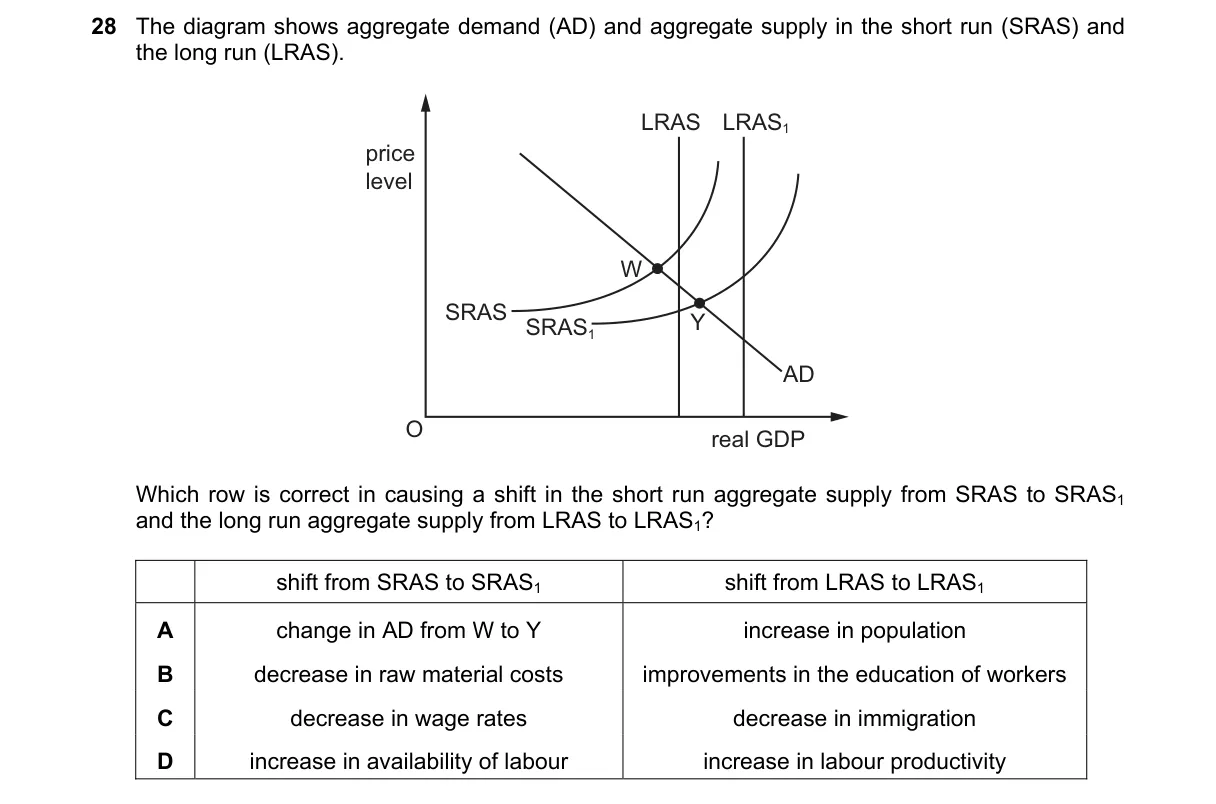
Answer choices
- AOption A
- Bdecrease in raw material costs improvements in the education of workers
- Cdecrease in availability of labour decrease in immigration
- Dincrease in availability of labour increase in labour productivity
Explanation
Shifts in SRAS and LRAS curves
Steps:
- SRAS shifts right from lower input costs, increasing output at each price level.
- LRAS shifts right from productivity gains, raising potential output.
- Match options to causes: B links cost reductions to SRAS and education to LRAS.
- Eliminate mismatches: C and D reverse labor effects; A (if cost-push) doesn't fit both.
Why B is correct:
- SRAS shifts right due to lower raw material costs reducing production expenses; LRAS shifts right as education boosts worker productivity and long-run capacity.
Why the others are wrong:
- A: Fails to align specific cost decreases with SRAS and human capital with LRAS.
- C: Both factors decrease labor supply, shifting both curves left, not right.
- D: Labor increase shifts LRAS right but not necessarily SRAS; productivity fits LRAS but not as SRAS cause.
Final answer: B
Topic: Aggregate Demand and Aggregate Supply analysis
Practice more A Level Economics (9708) questions on mMCQ.me