A Level Economics (9708)•9708/13/M/J/23
A Level Economics (9708) — 9708/13/M/J/23, Question 23
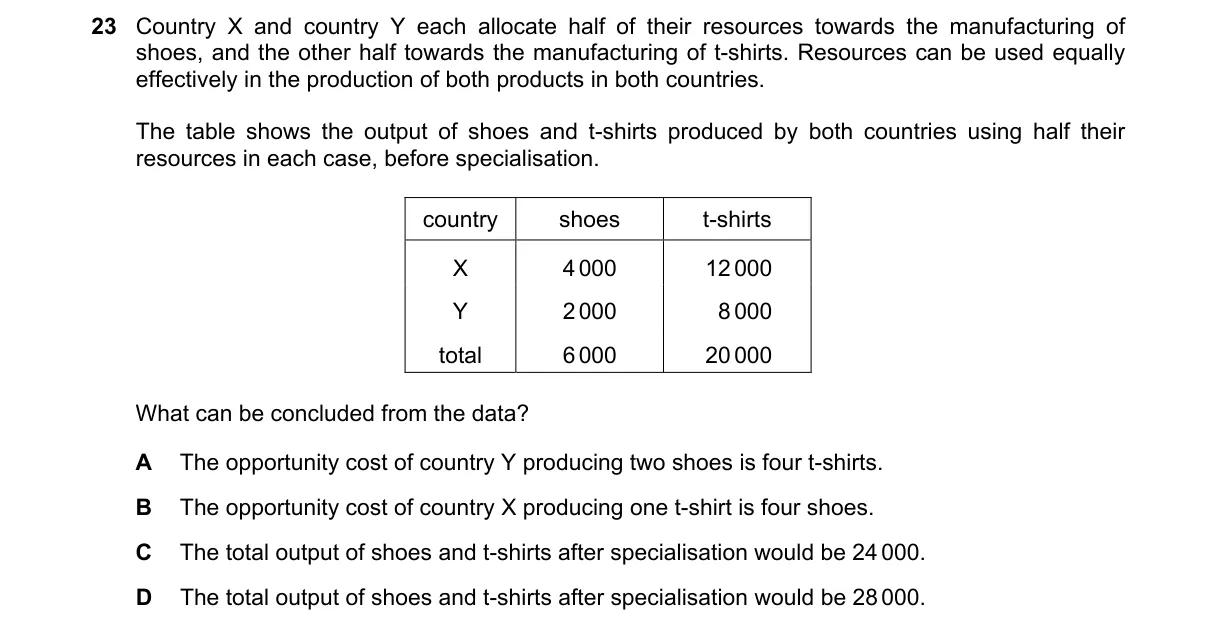
Country X and Country Y allocate half of their resources towards the manufacture of shoes and the other half towards the manufacture of t-shirts. Resources can be used equally effectively in the production of both products in both countries. The table shows the output of shoes and t-shirts produced by both countries using half their resources in each case. country shoes t-shirts X 4000 12000 Y 8000 20000 total 12000 32000 What can be concluded
Answer choices
- AThe opportunity cost of Country Y producing two shoes is four t-shirts.
- BThe opportunity cost of Country X producing one t-shirt is four shoes.
- CThe total output of shoes and t-shirts after specialisation would be 28000.
- DThe total output of shoes and t-shirts after specialisation would be 20000.
Explanation
Comparative Advantage Leads to Specialization Gains Steps:
- Calculate opportunity cost of shoes (in t-shirts forgone): X = 12,000 / 4,000 = 3 t-shirts per shoe; Y = 20,000 / 8,000 = 2.5 t-shirts per shoe.
- Y has lower opportunity cost for shoes, so specializes in shoes using all resources (8,000 × 2 = 16,000 shoes).
- X has lower opportunity cost for t-shirts, so specializes in t-shirts using all resources (12,000 t-shirts).
- Total output after specialization = 16,000 shoes + 12,000 t-shirts = 28,000 units. Why C is correct:
- Specialization according to comparative advantage reallocates resources to maximize efficient production, yielding 28,000 total units versus current 44,000, but enabling trade gains beyond autarky mix (law of comparative advantage). Why the others are wrong:
- A: Y's opportunity cost is 2.5 t-shirts per shoe, so two shoes cost 5 t-shirts, not 4.
- B: X's opportunity cost is 1/3 shoe per t-shirt, not 4 shoes.
- D: 20,000 assumes half-resource outputs without full reallocation (8,000 + 12,000).
Final answer: C
Topic: The reasons for international trade
Practice more A Level Economics (9708) questions on mMCQ.me