A Level Economics (9708)•9708/13/M/J/23
A Level Economics (9708) — 9708/13/M/J/23, Question 1
People plant flowers in a local park. Which statement is correct?
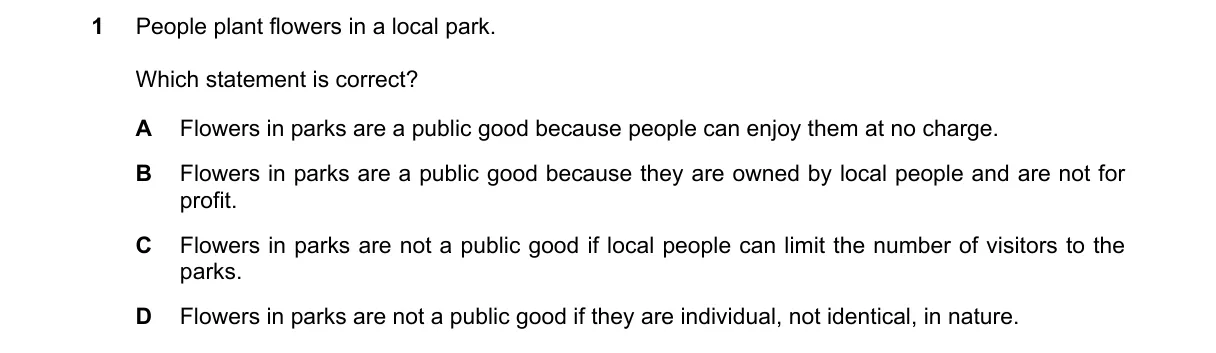
Answer choices
- AFlowers in parks are a public good because they are owned by local people and not for
- BFlowers in parks are a public good because people can enjoy them at no charge.
- CFlowers in parks are not a public good if local can limit the number of visitors to the
- DFlowers in parks are not a public good if they are individual, not identical, in nature.
Explanation
Public Goods in Economics
Steps:
- Define public good: non-excludable (cannot prevent use) and non-rivalrous (one person's use doesn't reduce others').
- Evaluate flowers in park: typically non-rivalrous but excludability depends on access control.
- Check options: A misstates ownership; B ignores rivalry/excludability; C addresses excludability via visitor limits; D confuses with heterogeneity.
- Select C as it correctly identifies condition making it not a public good.
Why C is correct:
- Public goods require non-excludability; limiting visitors makes flowers excludable, violating the definition.
Why the others are wrong:
- A: Ownership by locals doesn't define public goods; they are collectively provided, not privately owned.
- B: Free enjoyment covers non-excludability but ignores non-rivalry, incomplete for public good status.
- D: Individual variation is irrelevant; public goods can differ but must meet excludability/rivalry criteria.
Final answer: C
Topic: Classification of goods and services
Practice more A Level Economics (9708) questions on mMCQ.me