A Level Economics (9708)•9708/12/M/J/23
A Level Economics (9708) — 9708/12/M/J/23, Question 8
The cross elasticity of demand between bus travel and rail travel is –2. A rise in the price of bus fares caused the demand for rail travel to rise by 10%. Which change in bus fares would have caused this?
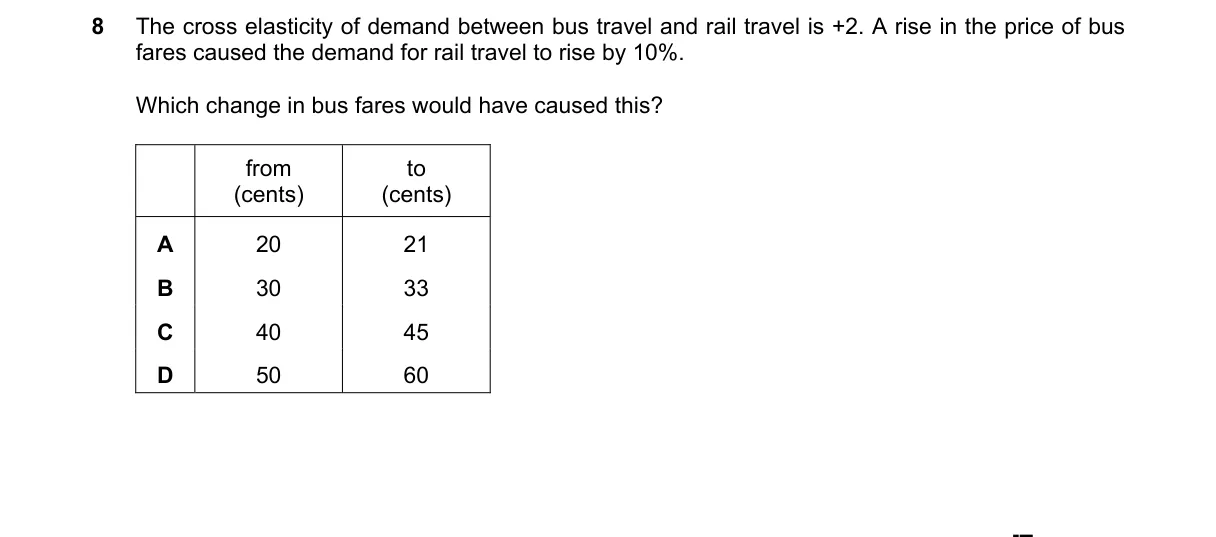
Answer choices
- Afrom 20 cents to 21 cents
- Bfrom 30 cents to 33 cents
- Cfrom 40 cents to 45 cents
- Dfrom 50 cents to 60 cents
Explanation
Cross Elasticity Formula Application
Steps:
- Recall cross elasticity of demand (XED) formula: XED = (% change in rail demand) / (% change in bus price).
- Given XED = -2 (indicating substitutes, absolute value 2) and % change in rail demand = +10%.
- Solve for % change in bus price: 10% / 2 = 5% increase (using absolute value for substitute goods).
- Calculate % price changes: A = (1/20)×100=5%; B=10%; C=12.5%; D=20%.
Why A is correct:
- Matches the 5% bus price increase required by |XED| × %ΔP_bus = %ΔQ_rail.
Why the others are wrong:
- B: 10% exceeds the 5% needed, overestimating rail demand rise.
- C: 12.5% too high, implying larger rail demand change than 10%.
- D: 20% far exceeds 5%, inconsistent with given elasticity.
Final answer: A
Topic: Price elasticity, income elasticity and cross elasticity of demand
Practice more A Level Economics (9708) questions on mMCQ.me