A Level Economics (9708)•9708/12/M/J/23
A Level Economics (9708) — 9708/12/M/J/23, Question 4
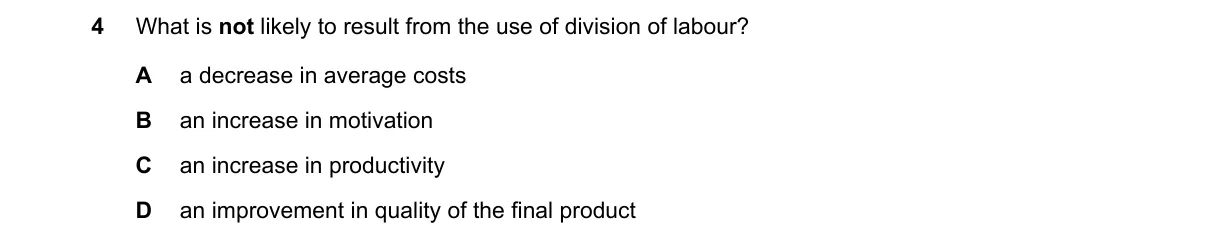
What is not likely to result from the use of division of labour
Answer choices
- Aa decrease in average costs
- Ban increase in motivation
- Can increase in productivity
- Dan improvement in quality of the final product
Explanation
Division of labour enhances efficiency but harms motivation
Steps:
- Division of labour splits tasks for specialization, raising overall output.
- It typically lowers costs, boosts productivity, and improves quality via expertise.
- However, repetitive tasks often cause boredom, reducing worker motivation.
- Thus, increased motivation is unlikely, making B the exception.
Why B is correct:
- Per Adam Smith's theory, division of labour creates monotonous routines that demotivate workers by limiting skill variety and job satisfaction.
Why the others are wrong:
- A: Specialization reduces average costs through economies of scale and efficiency gains.
- C: Focused tasks increase productivity by allowing faster, more skilled work.
- D: Expertise from repetition enhances precision and quality in the final product.
Final answer: B
Topic: Factors of production
Practice more A Level Economics (9708) questions on mMCQ.me