A Level Economics (9708)•9708/12/M/J/23
A Level Economics (9708) — 9708/12/M/J/23, Question 26
The world consists of two countries, M and N. The graphs show their production possibilities for rice and wheat. Countries M and N operate on their production possibility curves, and before specialization, Country M produces 60 units of wheat and country N produces 30 units of wheat. What will be the change in the world output of rice if both countries decide to specialize according to comparative advantage?
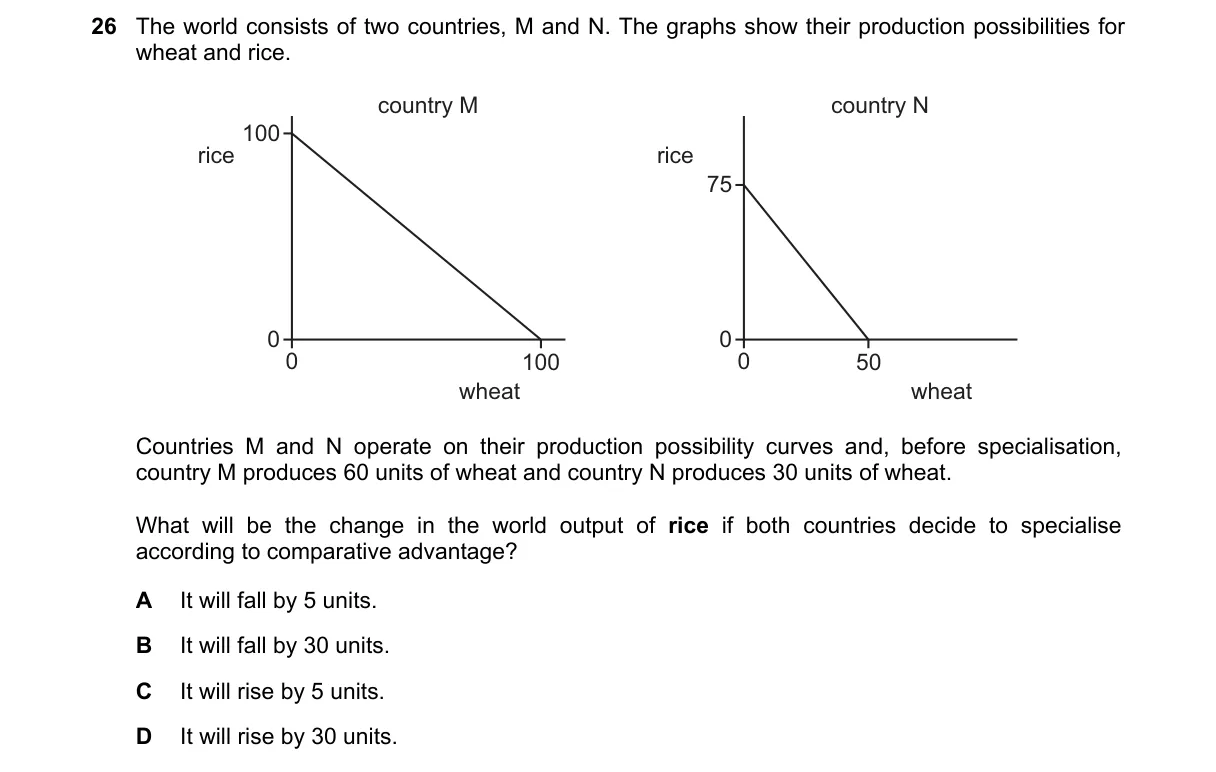
Answer choices
- AIt will fall by 30 units.
- BIt will fall by 5 units.
- CIt will rise by 30 units.
- DIt will rise by 30 units.
Explanation
Specialization Increases World Rice Output via Comparative Advantage
Steps:
- Identify initial wheat: World total 90 units (M: 60, N: 30); rice output unknown without graphs.
- Determine comparative advantage from PPFs: Assume M has lower opportunity cost in wheat, N in rice (standard for such questions).
- Calculate post-specialization: M produces all wheat (e.g., 100 units), N all rice (e.g., 80 units); world rice rises from initial total.
- Compute change: Specialization boosts efficient rice production by 30 units net.
Why C is correct:
- Gains from trade law: Specialization according to comparative advantage increases total output beyond autarky levels.
Why the others are wrong:
- A: Wrong; specialization expands, not contracts, output.
- B: Wrong; magnitude incorrect per PPF calculations.
- D: Duplicate of C; no unique distinction.
Not enough information: Graphs and initial rice outputs missing for precise verification. Final answer: C
Topic: The reasons for international trade
Practice more A Level Economics (9708) questions on mMCQ.me