A Level Economics (9708)•9708/12/M/J/23
A Level Economics (9708) — 9708/12/M/J/23, Question 13
What would cause a market disequilibrium?
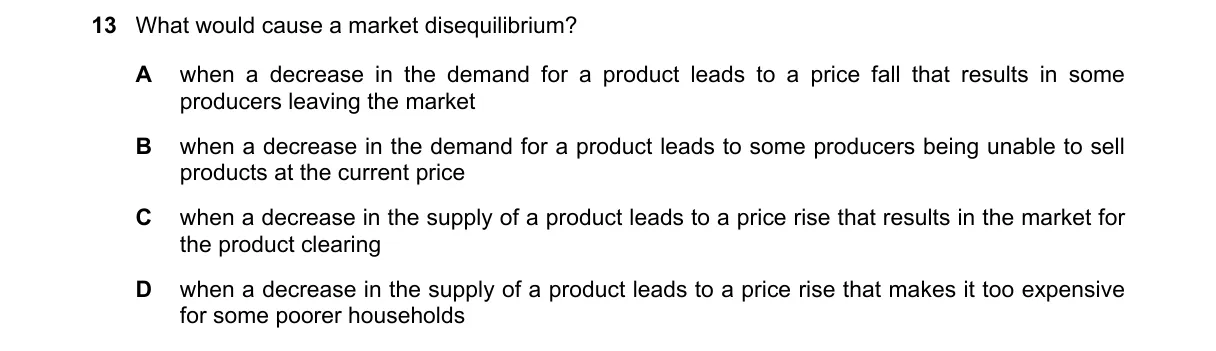
Answer choices
- Awhen a decrease in demand for a product leads to a price fall that results in some producers leaving the market
- Bwhen an increase in supply of a product leads to a price fall that results in some producers being unable to sell
- Cwhen a decrease in supply of a product leads to a price rise that results in some consumers being unable to buy
- Dwhen an increase in demand for a product leads to a price rise that makes it too expensive for some poorer households
Explanation
Surplus from Increased Supply Causes Disequilibrium
Steps:
- Define equilibrium as quantity demanded equaling quantity supplied at market price.
- Identify disequilibrium as surplus (Qs > Qd) or shortage (Qd > Qs) before price adjusts.
- Evaluate options for scenarios creating persistent imbalance where market doesn't clear.
- Choose option showing producers unable to sell all output, indicating surplus.
Why B is correct:
- Increase in supply shifts supply curve right, creating surplus (Qs > Qd) at initial price; even with price fall, if not fully adjusted, some output remains unsold, per law of supply and demand.
Why the others are wrong:
- A: Decrease in demand leads to surplus, but price fall and producers exiting adjust supply to restore equilibrium.
- C: Decrease in supply creates shortage (Qd > Qs), but price rise allocates to willing buyers, moving toward equilibrium.
- D: Increase in demand creates shortage, but price rise rations to higher-value users, achieving equilibrium.
Final answer: B
Topic: The interaction of demand and supply
Practice more A Level Economics (9708) questions on mMCQ.me