A Level Economics (9708)•9708/12/M/J/23
A Level Economics (9708) — 9708/12/M/J/23, Question 11
Which statement about the elasticity of supply (PES) along this supply curve is correct?
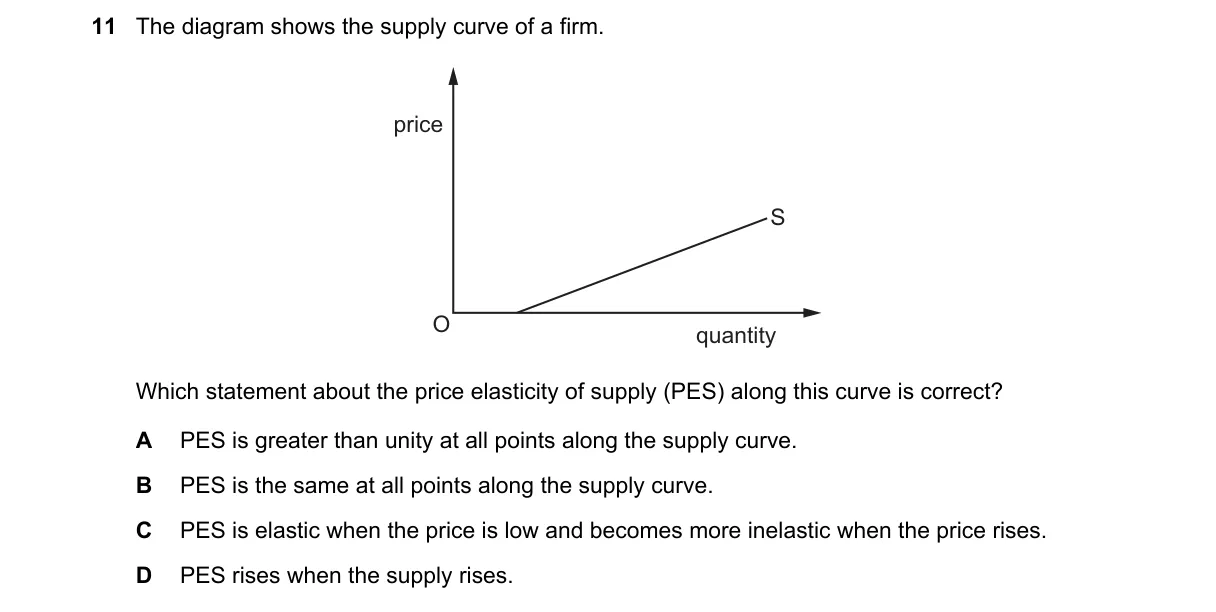
Answer choices
- APES is greater than unity at all points along the supply curve
- BPES is elastic when the price is low and becomes more inelastic when the price rises.
- CPES rises when supply rises and becomes more elastic when the price rises.
- DPES is the same at all points along the supply curve.
Explanation
Constant PES on a Linear Supply Curve from the Origin
Steps:
- Define PES as (% change in quantity supplied) / (% change in price).
- Identify the supply curve as linear and passing through the origin, so Q = kP.
- Calculate PES = (dQ/dP) * (P/Q) = k * (P / kP) = 1, constant at all points.
- Confirm no variation in elasticity since P/Q ratio remains fixed along the curve.
Why D is correct:
- For a linear supply curve through the origin, PES equals 1 everywhere per the formula PES = (slope) * (P/Q), as P/Q is constant.
Why the others are wrong:
- A: PES equals unity (1), not greater than 1.
- B: Describes varying PES on upward-intercept curves, but here it's constant.
- C: PES is a point measure and doesn't inherently rise with supply or price on this curve.
Final answer: D
Topic: Price elasticity of supply
Practice more A Level Economics (9708) questions on mMCQ.me