A Level Economics (9708)•9708/11/M/J/23
A Level Economics (9708) — 9708/11/M/J/23, Question 30
A government orders its bank to buy domestic currency on the foreign exchange markets in the belief that this will improve the balance of payments. What does this suggest?
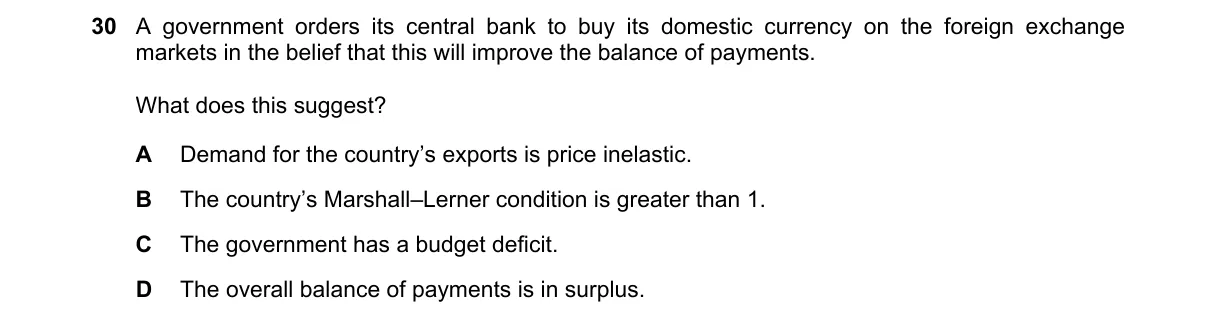
Answer choices
- ADemand for this country's exports is price inelastic.
- BThe country's Marshall-Lerner condition is greater than 1.
- CThe government has a budget deficit.
- DThe overall balance of payments is in surplus.
Explanation
Government believes currency appreciation boosts export revenue due to inelastic demand
Steps:
- Government orders buying domestic currency, increasing its value (appreciation).
- Appreciation raises foreign price of exports.
- If export demand is price inelastic, export quantity falls little, so total export value in foreign currency rises.
- This improves trade balance (part of BOP), aligning with the belief.
Why the correct option is correct:
- Price inelastic export demand means revenue increases with higher prices from appreciation, per basic elasticity definition (percentage change in quantity < percentage change in price).
Why the others are wrong:
- B: Marshall-Lerner >1 means high elasticities, so appreciation worsens trade balance by reducing export volume more than price gain.
- C: Budget deficit may indirectly affect BOP but does not explain forex intervention to appreciate currency.
- D: BOP surplus causes natural appreciation, so intervention would sell (not buy) domestic currency to prevent it.
Final answer: A
Topic: Policies to correct disequilibrium in the balance of payments
Practice more A Level Economics (9708) questions on mMCQ.me