A Level Economics (9708)•9708/11/M/J/23
A Level Economics (9708) — 9708/11/M/J/23, Question 23
The diagram shows production possibility curves for two countries, India and Japan. Which combination of outputs would be achieved if each country specialised in the product in which it has a comparative advantage?
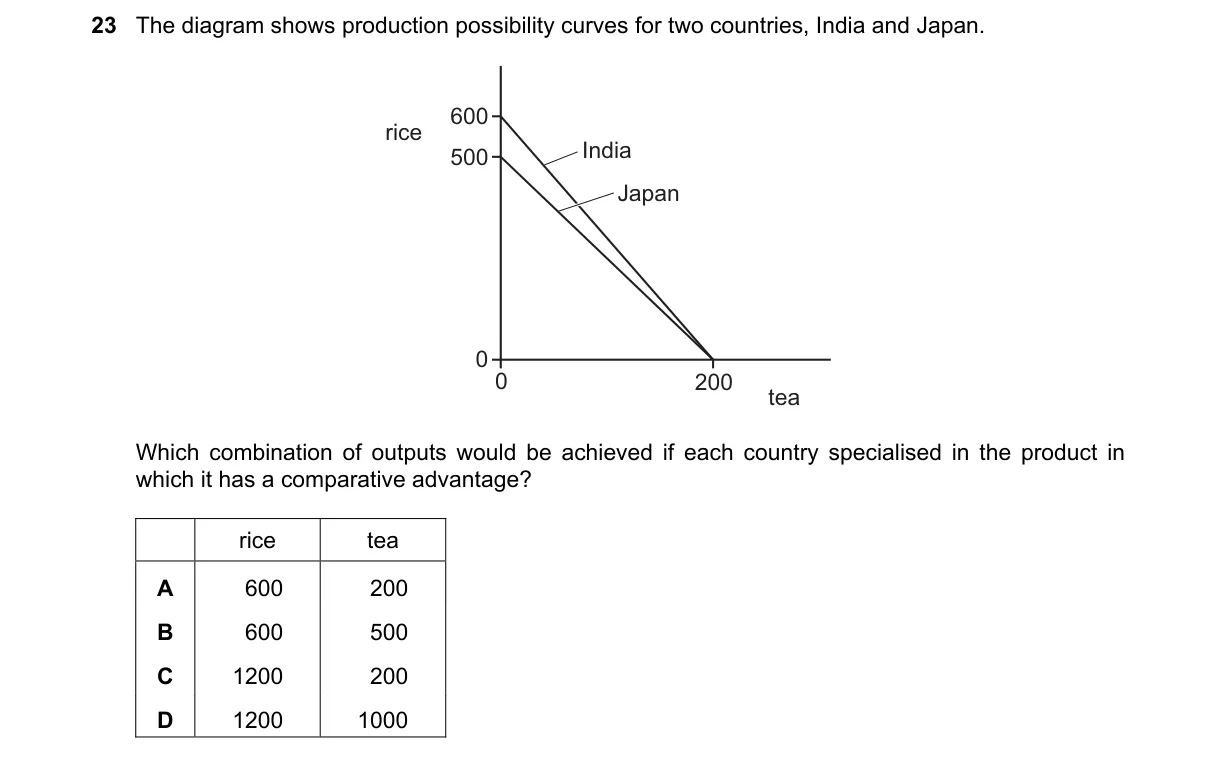
Answer choices
- Arice 600 tea 200
- B600 500
- C1200 500
- D1200 1000
Explanation
Specialization in Comparative Advantage
Steps:
- Calculate opportunity costs from PPCs: India sacrifices less tea for rice (advantage in rice); Japan sacrifices less rice for tea (advantage in tea).
- Assign specialization: India produces maximum rice (600 units); Japan produces maximum tea (200 units).
- Sum outputs for total production: rice from India only, tea from Japan only.
- Compare to choices: totals match rice 600, tea 200.
Why A is correct:
- Matches total output when countries specialize per comparative advantage, defined as lower opportunity cost, achieving efficient global production on combined PPC.
Why the others are wrong:
- B: Exceeds Japan's tea capacity, ignoring specialization limits.
- C: Doubles rice beyond India's maximum, not feasible without trade inefficiency.
- D: Unrealistic totals surpassing both countries' combined PPC frontiers.
Final answer: A
Topic: Production possibility curves
Practice more A Level Economics (9708) questions on mMCQ.me