A Level Economics (9708)•9708/11/M/J/23
A Level Economics (9708) — 9708/11/M/J/23, Question 22
The table shows data on the Japanese balance of goods. What can be concluded from data?
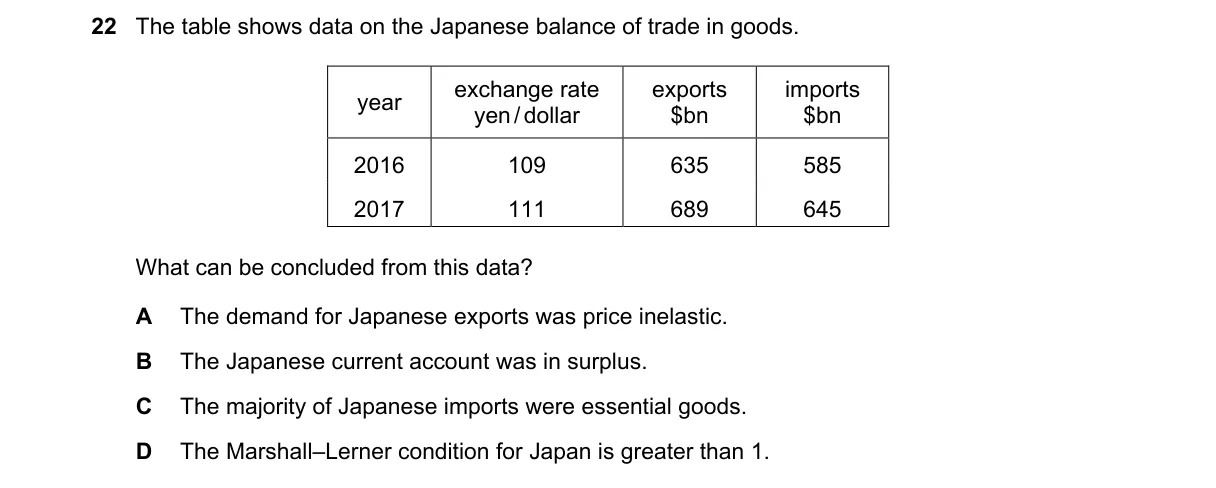
Answer choices
- AThe demand for Japanese exports was price inelastic.
- BThe Japanese current account was in surplus.
- CThe majority of Japanese imports were essential.
- DThe Marshall-Lerner condition for Japan is greater than 1.
Explanation
Insufficient data to analyze balance of goods
Steps:
- Identify key elements: Balance of goods data typically includes exports, imports, and surplus/deficit figures.
- Review choices: Each requires specific numerical evidence from the table (e.g., elasticities, surplus values).
- Assess availability: No table provided, so cannot verify exports vs. imports or elasticity implications.
- Conclude: Without data, no valid inference possible.
Why the correct option is correct:
- Not applicable; insufficient information prevents selection.
Why the others are wrong:
- A: Requires table data showing export volume unresponsive to price changes.
- B: Needs export values exceeding imports to confirm surplus.
- C: Demands import composition data indicating essential goods dominance.
- D: Involves elasticity sum >1, calculable only from price/quantity changes in table.
Final answer: Not enough information.
Topic: Current account of the balance of payments
Practice more A Level Economics (9708) questions on mMCQ.me