A Level Economics (9708)•9708/14/M/J/22
A Level Economics (9708) — 9708/14/M/J/22, Question 25
The currency of country X has a floating exchange rate against other currencies. Under which circumstances will the value of country X's currency fluctuate the most against other currencies on the foreign exchange market?
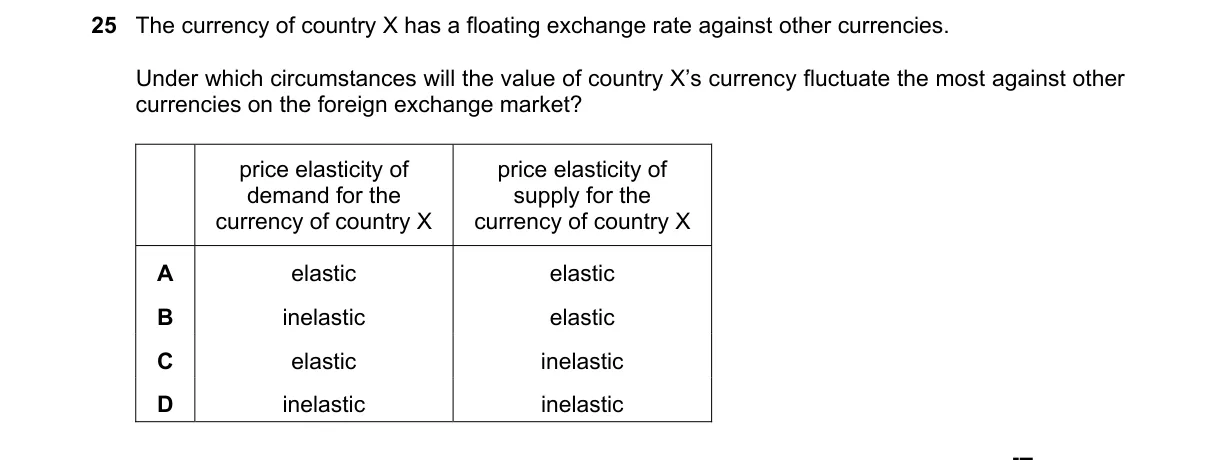
Answer choices
- Aelastic demand for the currency of country X and elastic supply of the currency of country X
- Binelastic demand for the currency of country X and elastic supply of the currency of country X
- Celastic demand for the currency of country X and inelastic supply of the currency of country X
- Dinelastic demand for the currency of country X and inelastic supply of the currency of country X
Explanation
Exchange Rate Volatility from Inelastic Supply and Demand
Steps:
- Exchange rate equilibrates supply and demand for currency X.
- Elasticity shows quantity response to price (exchange rate) changes.
- Inelastic curves shift with minimal quantity adjustment, amplifying price swings.
- Greatest volatility occurs when both are inelastic, as small shocks cause large rate shifts.
Why D is correct:
- In economics, price volatility maximizes when both demand and supply are inelastic, per the law of supply and demand, since quantity barely adjusts to shifts, forcing large equilibrium price changes.
Why the others are wrong:
- A: Elastic demand and supply buffer shifts with quantity changes, minimizing rate fluctuations.
- B: Elastic supply absorbs demand shifts via quantity, limiting price volatility.
- C: Elastic demand offsets supply shifts through quantity, reducing rate swings.
Final answer: D
Topic: Exchange rates
Practice more A Level Economics (9708) questions on mMCQ.me