A Level Economics (9708)•9708/14/M/J/22
A Level Economics (9708) — 9708/14/M/J/22, Question 24
The diagram shows an aggregate demand (AD) and aggregate supply (AS). There is a sustained rise in the prices of imported raw materials on which the economy depends. Assuming AD remains independent of AS, what are the most likely effects on the economy?
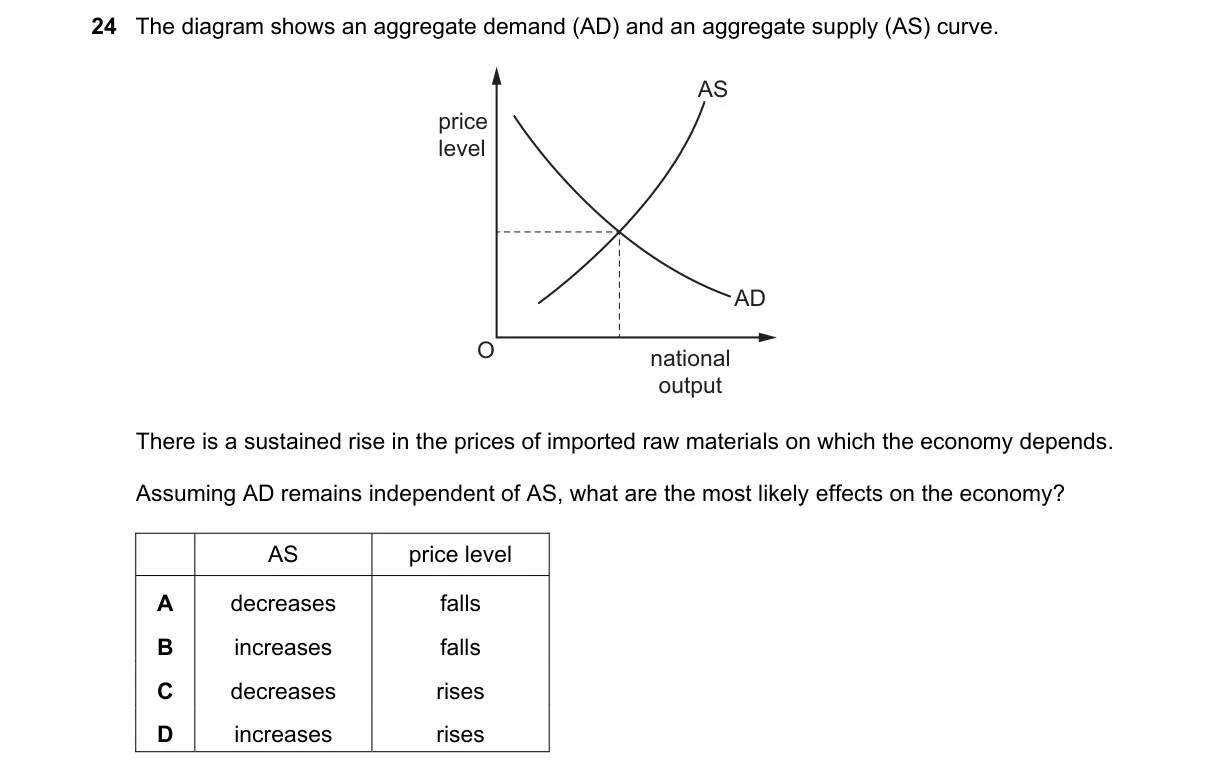
Answer choices
- AAS decreases, price level falls
- BAS decreases, price level rises
- CAS increases, price level falls
- DAS increases, price level rises
Explanation
Cost-Push Inflation from Higher Import Costs
Steps:
- Rising prices of imported raw materials increase production costs for firms.
- Higher costs shift the aggregate supply (AS) curve leftward, decreasing AS.
- With AD unchanged, the new equilibrium has higher price level and lower output.
- This results in stagflation: rising prices and economic slowdown.
Why B is correct:
- A leftward AS shift raises the price level due to the inverse relationship between AS and prices in the AD-AS model.
Why the others are wrong:
- A: AS decrease raises prices, not lowers them.
- C: AS does not increase; costs rise, reducing supply.
- D: AS does not increase; higher costs constrain production.
Final answer: B
Topic: Aggregate Demand and Aggregate Supply analysis
Practice more A Level Economics (9708) questions on mMCQ.me