A Level Economics (9708)•9708/13/M/J/22
A Level Economics (9708) — 9708/13/M/J/22, Question 6
The supply of a new drug to relieve muscle pain is inelastic over a short period of time. The supply of printed newspapers is much more elastic over the same period. What could explain the difference in elasticity of supply of the drug and printed newspapers in this time period?
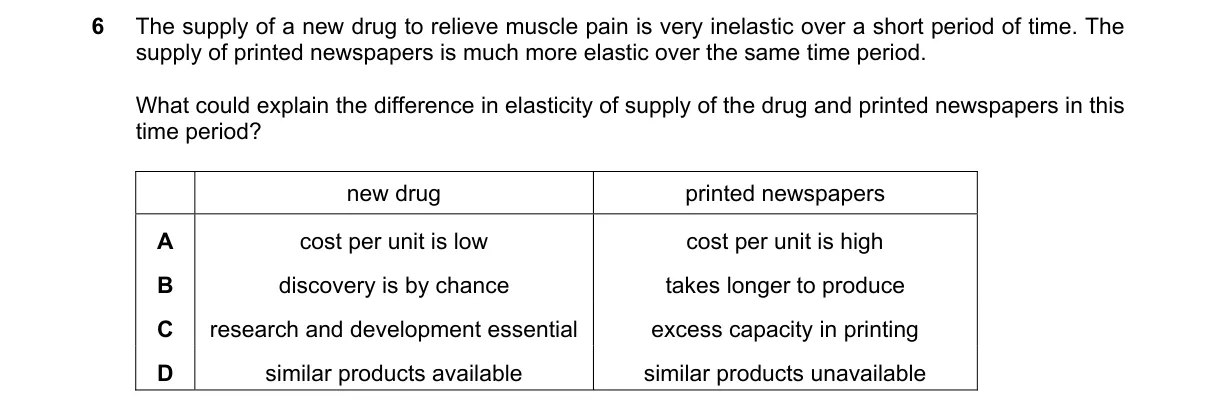
Answer choices
- ANew drug: cost per unit is low; Printed newspapers: cost per unit is high
- BNew drug: discovery by chance; Printed newspapers: takes longer to produce
- CNew drug: research and development essential; Printed newspapers: excess capacity in printing
- DNew drug: similar products available; Printed newspapers: similar products unavailable
Explanation
Short-run supply elasticity depends on production adjustability
Steps:
- Recall supply elasticity measures how quickly quantity supplied responds to price changes; inelastic means limited short-run response.
- For the new drug, extensive research, testing, and approval processes prevent rapid production scaling, making supply inelastic.
- For printed newspapers, existing printing facilities with spare capacity allow quick output increases via extra shifts or runs, making supply elastic.
- Evaluate choices: Only C explains the time-based production differences driving elasticity variances.
Why C is correct:
- Supply elasticity is higher with excess capacity (quick adjustment possible) and lower when fixed factors like R&D require long lead times, per economic definition of short-run constraints.
Why the others are wrong:
- A: Unit costs affect profitability, not the speed of production adjustment for elasticity.
- B: Chance discovery is irrelevant to supply response; newspaper production is fast, not longer.
- D: Product similarity impacts demand elasticity via substitutes, not supply elasticity.
Final answer: C
Topic: Price elasticity of supply
Practice more A Level Economics (9708) questions on mMCQ.me