A Level Economics (9708)•9708/13/M/J/22
A Level Economics (9708) — 9708/13/M/J/22, Question 27
In 2000, Japan was Asia's largest exporter of electrical components, but by 2018 it was ranked 8th. What might explain this change?
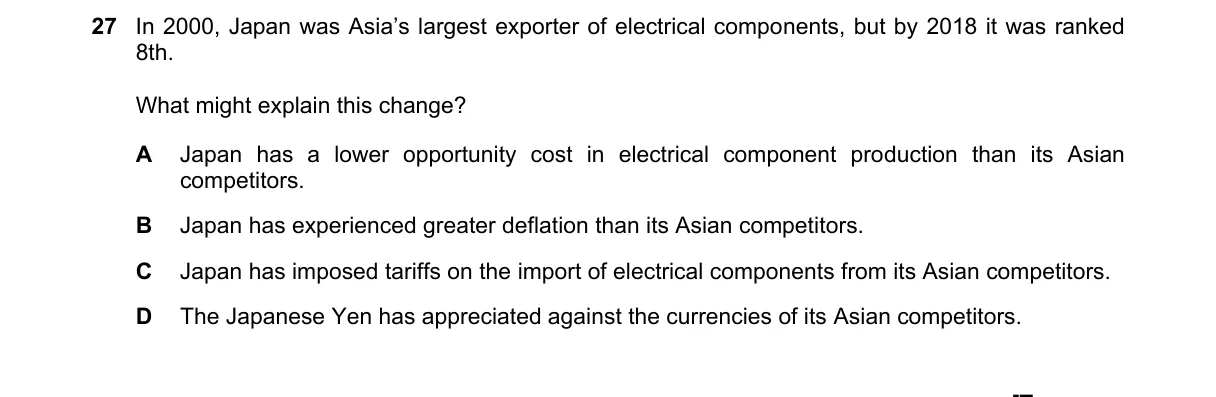
Answer choices
- AJapan has a lower opportunity cost in electrical component production than its Asian competitors.
- BJapan has imposed tariffs on the import of electrical components from Asian competitors.
- CJapan has experienced greater deflation than its Asian competitors.
- DThe Japanese Yen has appreciated against the currencies of its Asian competitors.
Explanation
Currency Appreciation Reduces Export Competitiveness
Steps:
- Identify the decline in Japan's export ranking from 1st to 8th in electrical components.
- Consider economic factors affecting export performance, such as costs and competitiveness.
- Evaluate how currency changes influence trade: stronger currency raises export prices abroad.
- Match to option D, as yen appreciation would make Japanese goods costlier for foreign buyers.
Why D is correct:
- Currency appreciation increases the relative price of exports in foreign markets, reducing demand and competitiveness per the law of demand.
Why the others are wrong:
- A: Lower opportunity cost would enhance, not diminish, Japan's export advantage.
- B: Tariffs on imports protect domestic producers but do not directly explain falling exports.
- C: Greater deflation lowers production costs, potentially boosting exports rather than harming them.
Final answer: D
Topic: Exchange rates
Practice more A Level Economics (9708) questions on mMCQ.me