A Level Economics (9708)•9708/13/M/J/22
A Level Economics (9708) — 9708/13/M/J/22, Question 26
The diagram shows aggregate demand (AD) and aggregate supply (AS) for a country. Initial equilibrium is at point E. A devaluation of the country's exchange rate will cause aggregate demand to shift. What will be the new equilibrium?
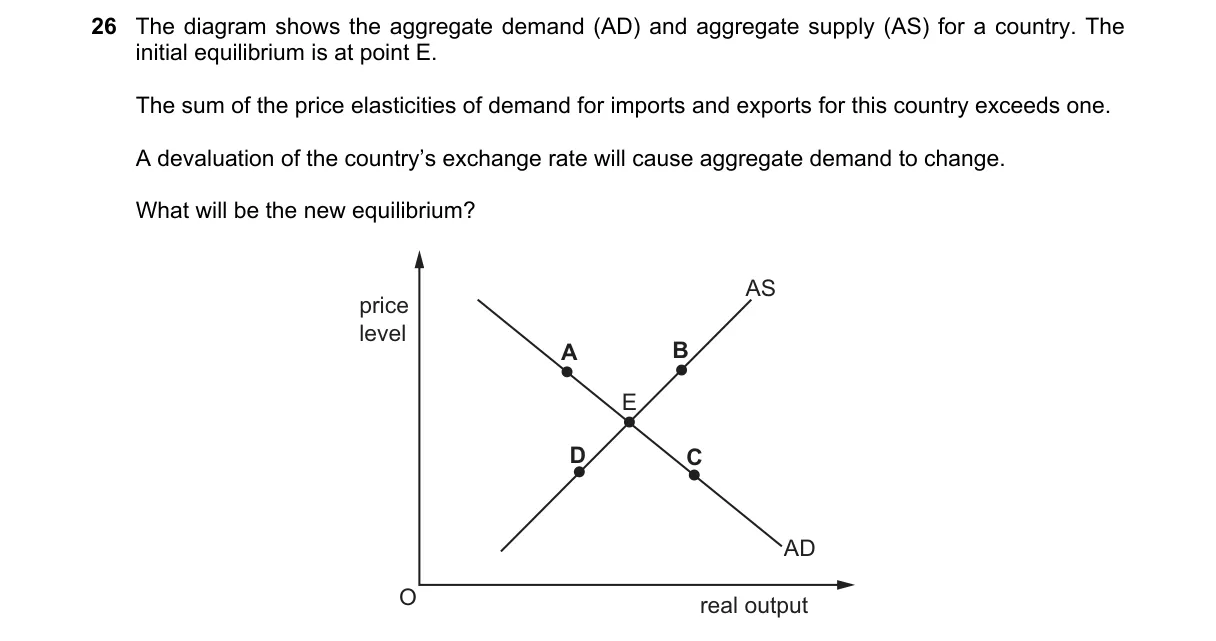
Answer choices
- AOption A
- BOption B
- COption C
- DOption D
Explanation
Devaluation Shifts AD Rightward, Raising Output and Prices
Steps:
- Devaluation lowers the currency value, making exports cheaper and imports costlier, increasing net exports.
- Net exports are a component of AD, so the AD curve shifts right.
- The new AD intersects the unchanged short-run AS at a higher output level and price level.
- This new intersection point is the equilibrium.
Why B is correct:
- B depicts higher equilibrium output and price level, matching the rightward AD shift per the AD-AS model.
Why the others are wrong:
- A: Shows lower output and prices, implying leftward AD shift.
- C: Indicates unchanged output but higher prices, suggesting vertical long-run AS.
- D: Represents no shift, maintaining original equilibrium.
Final answer: B
Topic: Aggregate Demand and Aggregate Supply analysis
Practice more A Level Economics (9708) questions on mMCQ.me