A Level Economics (9708)•9708/13/M/J/22
A Level Economics (9708) — 9708/13/M/J/22, Question 12
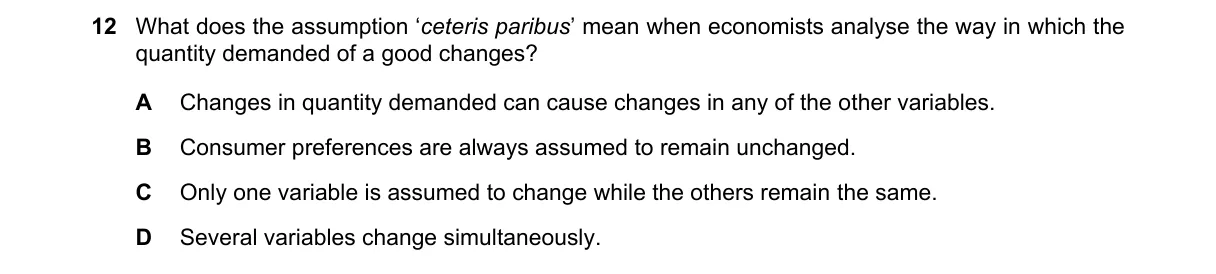
What does the assumption 'ceteris paribus' mean when economists analyse the way in which the quantity demanded of a good changes?
Answer choices
- AChanges in quantity demanded can cause changes in any of the other variables.
- BOnly one variable is assumed to change while the others remain unchanged.
- CConsumer preferences are always assumed to remain unchanged.
- DSeveral variables change simultaneously.
Explanation
Ceteris Paribus Holds Other Factors Constant
Steps:
- Recall that "ceteris paribus" is Latin for "all other things equal" in economics.
- In demand analysis, it isolates the effect of one variable, like price, on quantity demanded.
- This assumption prevents confounding influences from income, tastes, or prices of related goods.
- Apply to choices: identify which describes isolating one change while fixing others.
Why B is correct:
- It directly matches the definition, assuming only the variable of interest (e.g., price) changes while all others (like income or preferences) stay constant to analyze demand curves.
Why the others are wrong:
- A: Reverses causality; ceteris paribus focuses on controlled analysis, not causation in any direction.
- C: Too narrow; it holds all non-price factors constant, not just preferences.
- D: Opposite of the assumption, which prevents simultaneous changes for clarity.
Final answer: B
Topic: Economic methodology
Practice more A Level Economics (9708) questions on mMCQ.me