A Level Economics (9708)•9708/12/M/J/22
A Level Economics (9708) — 9708/12/M/J/22, Question 9
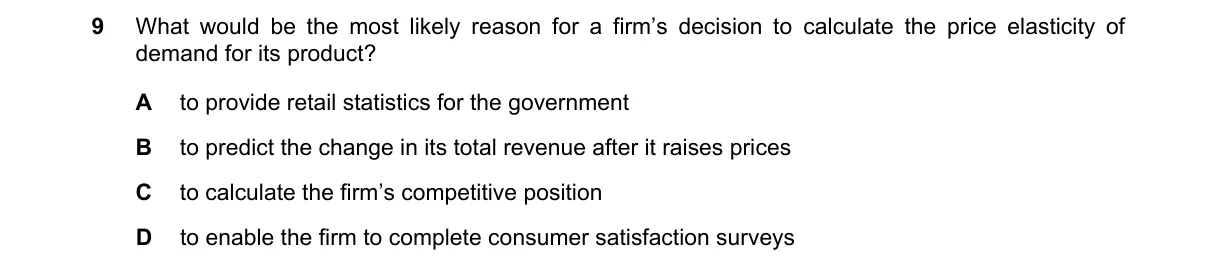
What would be the most likely reason for a firm's decision to calculate the price elasticity of demand for its product?
Answer choices
- Ato provide statistics for the government
- Bto predict changes in total revenue after raises prices
- Cto calculate the firm's competitive position after raises prices
- Dto enable the firm to complete consumer satisfaction surveys
Explanation
Price Elasticity Guides Revenue Forecasting
Steps:
- Recall price elasticity of demand measures how quantity demanded responds to price changes.
- Link elasticity to total revenue: revenue = price × quantity.
- Analyze scenarios: elastic demand means price increase reduces revenue; inelastic means it increases revenue.
- Match to choices: identify option focused on revenue prediction post-price change.
Why B is correct:
- Price elasticity determines revenue impact via the formula TR = P × Q; if |E_d| > 1 (elastic), raising price decreases TR, aiding forecast decisions.
Why the others are wrong:
- A: Firms calculate elasticity for internal strategy, not government reporting.
- C: Elasticity assesses own demand sensitivity, not direct competitive positioning.
- D: Surveys measure satisfaction, unrelated to elasticity's economic responsiveness focus.
Final answer: B
Topic: Price elasticity, income elasticity and cross elasticity of demand
Practice more A Level Economics (9708) questions on mMCQ.me