A Level Economics (9708)•9708/12/M/J/22
A Level Economics (9708) — 9708/12/M/J/22, Question 5
In which situation is the price elasticity of supply for a product most likely to be relatively low?
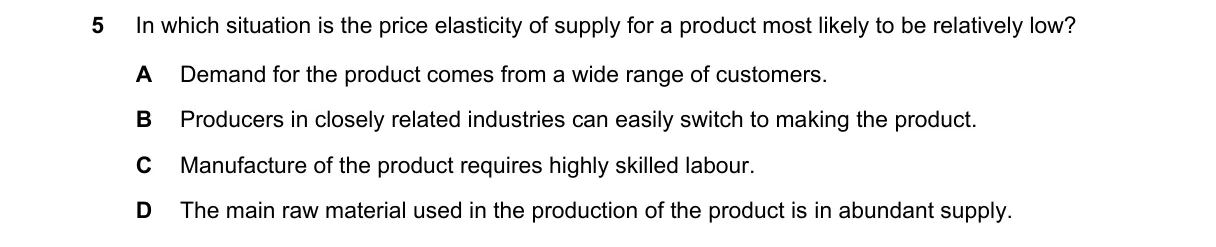
Answer choices
- ADemand for the product comes from a wide range of customers.
- BProducers in closely related industries can easily switch to making the product.
- CManufacture of the product requires highly skilled labour.
- DThe main raw material used in the production of the product is in abundant supply.
Explanation
Supply elasticity low when production constraints limit quick scaling
Steps:
- Recall price elasticity of supply (PES) measures how much quantity supplied changes with price; low PES occurs with fixed or hard-to-expand inputs.
- Eliminate A: It describes demand side, irrelevant to supply responsiveness.
- Eliminate B: Easy industry switching expands supply quickly, raising PES.
- Identify C: Skilled labor supply is inelastic, constraining production ramps.
- Confirm D: Abundant materials enable easy output increases, boosting PES.
Why C is correct:
- Skilled labor has low short-run supply elasticity due to training time, limiting producers' ability to respond to price rises (PES < 1).
Why the others are wrong:
- A: Focuses on demand diversity, not supply factors affecting PES.
- B: Facilitates rapid supply expansion, making PES high.
- D: Reduces input bottlenecks, allowing elastic supply response.
Final answer: C
Topic: Price elasticity of supply
Practice more A Level Economics (9708) questions on mMCQ.me