A Level Economics (9708)•9708/12/M/J/22
A Level Economics (9708) — 9708/12/M/J/22, Question 14
Which combination of tax changes is most likely to be regressive in a developed economy?
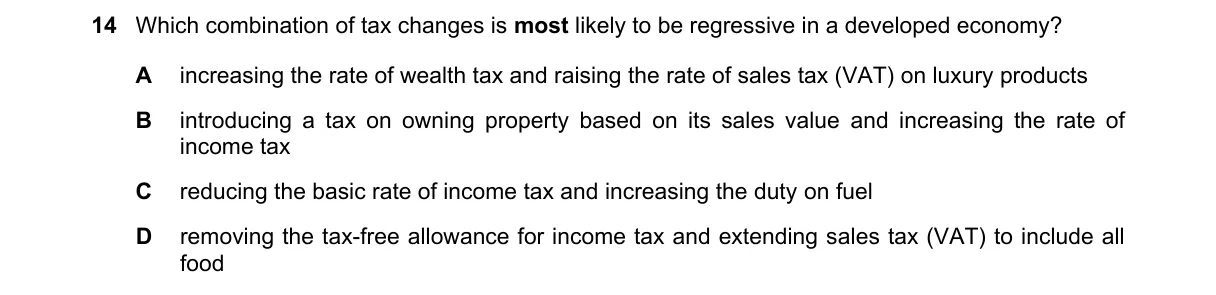
Answer choices
- Aincreasing the rate of wealth tax and raising the rate of sales (VAT) on luxury products
- Bintroducing a tax on property based on its value and increasing the rate
- Creducing the basic rate of income tax and increasing the duty on fuel
- Dremoving the tax-free allowance for income tax and extending sales tax (VAT) to include all food
Explanation
Regressive taxes burden low-income earners disproportionately
Steps:
- Define regressive tax: imposes higher effective rate on low incomes relative to high incomes.
- Evaluate options: assess if changes target essentials (regressive) or wealth/luxuries (progressive).
- Compare impacts: low earners spend larger income shares on necessities like food/fuel.
- Identify worst: combination hitting basics without offsets.
Why D is correct:
- Removing income tax-free allowance taxes low earners' full income (regressive per ability-to-pay principle); VAT on all food burdens poor, who allocate 20-30% of income to food vs. 5-10% for rich.
Why the others are wrong:
- A: Wealth tax and luxury VAT target high incomes/assets, making it progressive.
- B: Value-based property tax is progressive, as wealthy own more valuable properties.
- C: Basic income tax cut benefits low earners; fuel duty is somewhat regressive but overall less so than D.
Final answer: D
Topic: Equity and redistribution of income and wealth
Practice more A Level Economics (9708) questions on mMCQ.me