A Level Economics (9708)•9708/11/M/J/22
A Level Economics (9708) — 9708/11/M/J/22, Question 30
The government of a country is worried about a large deficit on the current account of its balance of payments and an increasing rate of inflation. The country has a fixed exchange rate for its currency. Which policy rate is most likely to help the government reduce the current account deficit and lower the rate of inflation?
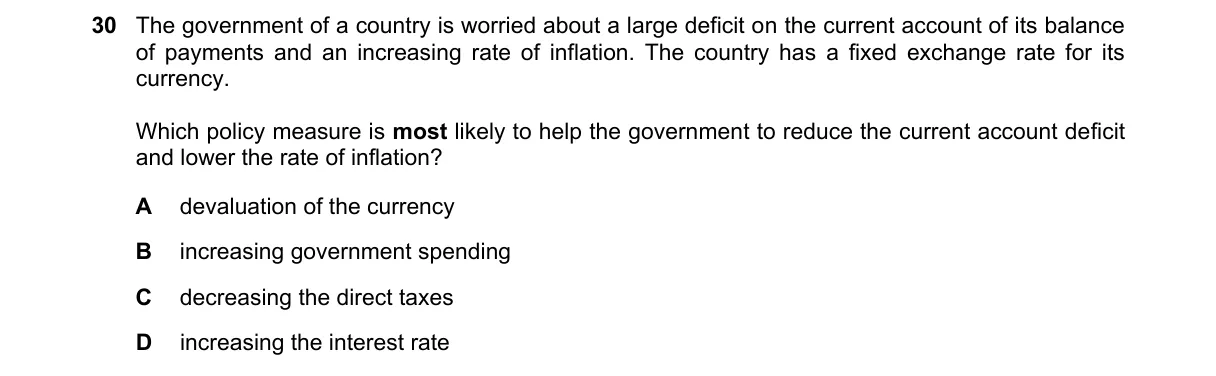
Answer choices
- Adevaluation of the currency
- Bincreasing government spending
- Cdecreasing the direct taxes
- Dincreasing the interest rate
Explanation
Tightening monetary policy to address twin deficits under fixed exchange rates
Steps:
- Identify goals: Reduce current account deficit (improve trade balance) and lower inflation.
- Consider fixed exchange rate constraint: Limits currency devaluation; focus on domestic policies.
- Evaluate options: Fiscal expansion worsens deficits; monetary tightening curbs demand and capital inflows.
- Select best: Higher interest rates reduce spending, imports, and inflation while attracting capital to support the currency.
Why D is correct:
- Increasing interest rates raises borrowing costs, reducing aggregate demand, which curbs inflation and import demand per the absorption approach (CA = Y - A, where higher rates lower absorption A).
Why the others are wrong:
- A: Devaluation is not feasible under fixed rates without breaking the peg.
- B: Increases aggregate demand, worsening inflation and current account deficit.
- C: Boosts disposable income and spending, fueling inflation and imports.
Final answer: D
Topic: Policies to correct imbalances in the current account of the balance of payments
Practice more A Level Economics (9708) questions on mMCQ.me