A Level Economics (9708)•9708/11/M/J/22
A Level Economics (9708) — 9708/11/M/J/22, Question 27
The central bank of an economy decides to raise interest rates in order to attract capital inflows and improve the financial account of the balance of payments. When is the central bank's decision least likely to be effective?
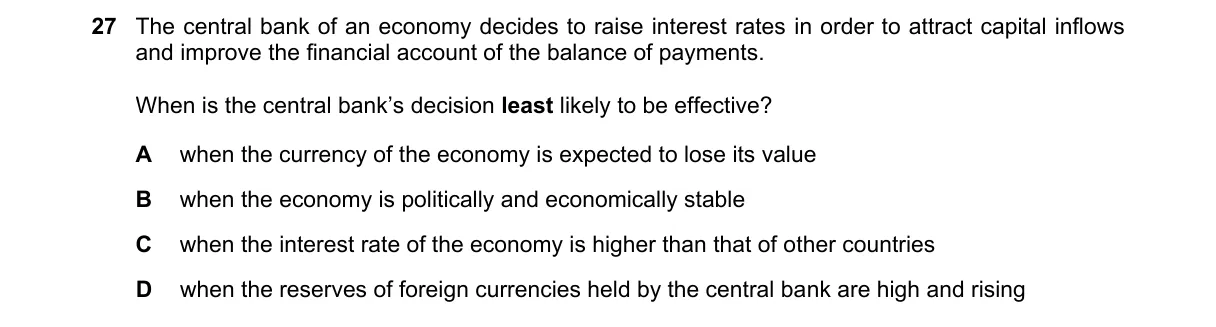
Answer choices
- AWhen the currency of the economy is expected to lose value
- Bwhen the economy is politically and economically stable
- Cwhen the interest rate of the economy is higher than that of other countries
- Dwhen the reserves of foreign currencies held by the central bank are high and rising
Explanation
Currency Depreciation Expectations Offset Interest Rate Gains
Steps:
- Central banks raise rates to make domestic assets more attractive for higher yields, drawing capital inflows.
- Capital flows depend on net returns, including interest differentials minus expected currency changes.
- If depreciation is anticipated, investors expect losses on currency conversion, reducing appeal of higher rates.
- Thus, inflows weaken, impairing financial account improvement.
Why A is correct:
- Uncovered interest parity theory states expected depreciation erodes interest rate advantages, deterring capital inflows.
Why the others are wrong:
- B: Stability boosts investor confidence, amplifying rate hikes' pull on capital.
- C: Higher relative rates directly enhance competitiveness for inflows.
- D: Rising reserves signal economic strength, reinforcing policy credibility and effectiveness.
Final answer: A
Topic: Policies to correct disequilibrium in the balance of payments
Practice more A Level Economics (9708) questions on mMCQ.me