A Level Economics (9708)•9708/11/M/J/22
A Level Economics (9708) — 9708/11/M/J/22, Question 22
The aggregate demand (AD) and aggregate supply (AS) diagram shows an economy in equilibrium at X. A severe shortage of raw materials causes a large rise in their price. The effect of this change is shown by a move to which point?
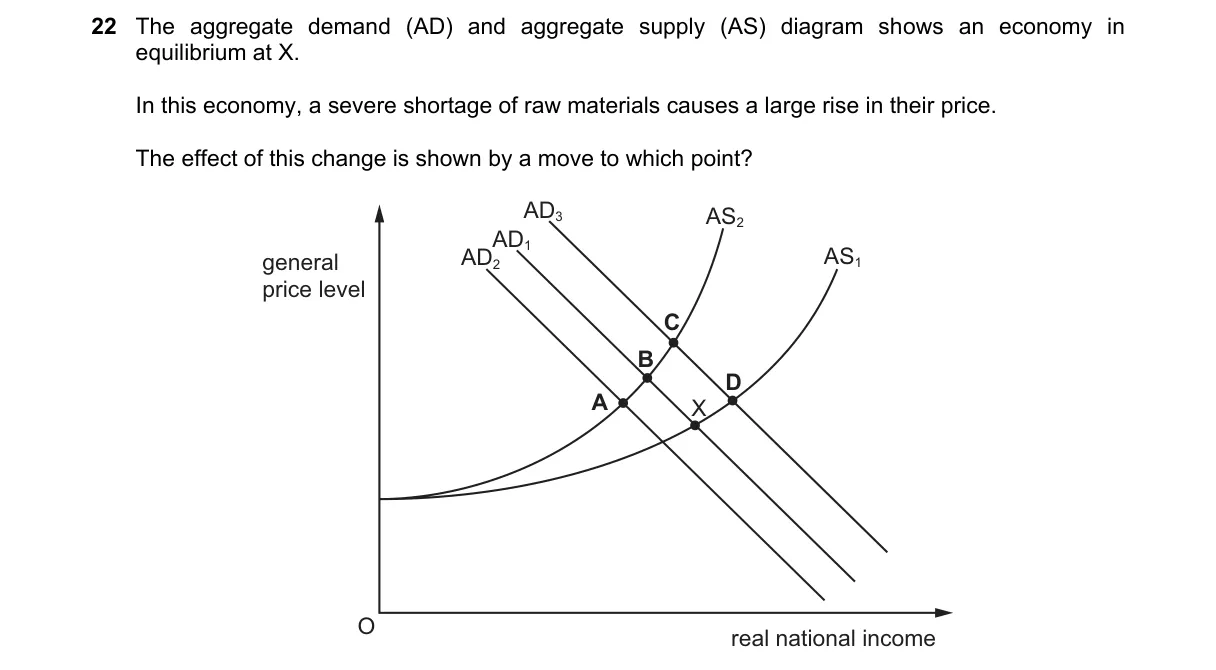
Answer choices
- AOption A
- BOption B
- COption C
- DOption D
Explanation
Supply Shock Shifts SRAS Leftward
Steps:
- Shortage of raw materials increases input costs for firms.
- Higher costs reduce short-run aggregate supply, shifting SRAS curve left.
- New intersection of AD and shifted SRAS occurs at higher price level and lower real GDP.
- This stagflation equilibrium matches point B on the diagram.
Why B is correct:
- Negative supply shock, per AS-AD model, raises prices and cuts output via leftward SRAS shift.
Why the others are wrong:
- A: Shows demand expansion (rightward AD shift), increasing output and prices.
- C: Indicates demand contraction (leftward AD shift), lowering both output and prices.
- D: Represents long-run adjustment (vertical LRAS), restoring full employment without persistent inflation.
Final answer: B
Topic: Aggregate Demand and Aggregate Supply analysis
Practice more A Level Economics (9708) questions on mMCQ.me