A Level Economics (9708)•9708/11/M/J/22
A Level Economics (9708) — 9708/11/M/J/22, Question 15
A government decides to introduce tolls (charges) to drive on all major roads. What is most likely to happen to the number of journeys made on major roads and on minor roads?
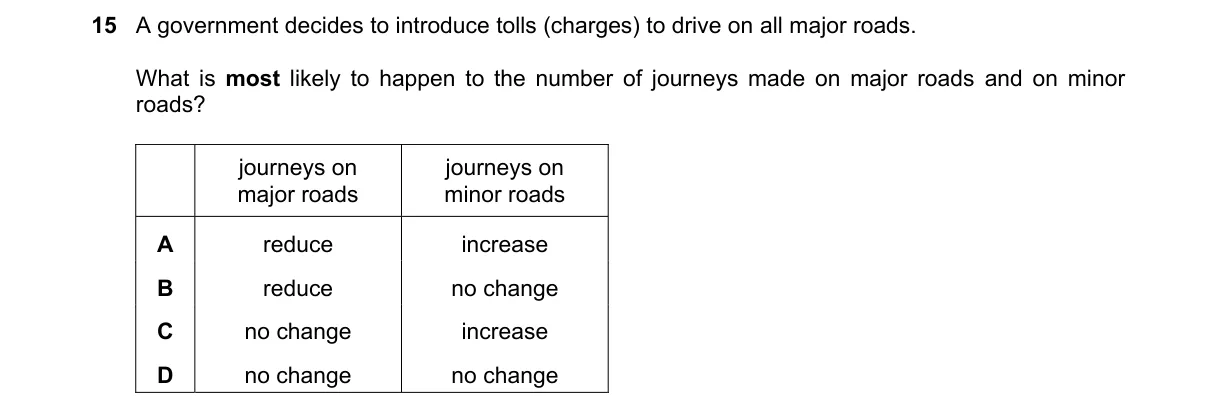
Answer choices
- Areduce (major roads), no increase (minor roads)
- Bno change (major roads), increase (minor roads)
- Creduce (major roads), increase (minor roads)
- Dno change (major roads), no change (minor roads)
Explanation
Tolls raise costs, reducing demand without full substitution Steps:
- Tolls increase the effective price of using major roads.
- Higher prices reduce quantity demanded per the law of demand, decreasing journeys on major roads.
- Some drivers may forgo trips entirely due to added costs, rather than switching routes.
- Minor roads lack capacity or convenience to absorb all diverted traffic, so usage does not rise.
Why A is correct:
- Law of demand predicts reduced major road journeys from tolls; incomplete substitution keeps minor road journeys stable, as not all trips shift or minor roads can't handle more volume.
Why the others are wrong:
- B: Tolls do change major road usage by raising costs and curbing demand.
- C: Assumes full traffic shift to minor roads, ignoring foregone trips and capacity limits.
- D: Ignores tolls' price effect, which reduces major road journeys.
Final answer: A
Topic: Methods and effects of government intervention in markets
Practice more A Level Economics (9708) questions on mMCQ.me