A Level Economics (9708)•9708/13/M/J/21
A Level Economics (9708) — 9708/13/M/J/21, Question 29
Which government policy would be most effective to prevent deflation?
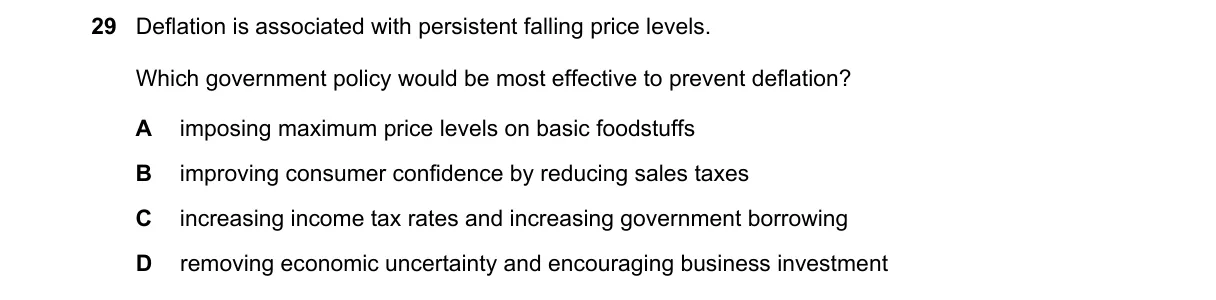
Answer choices
- AImposing maximum price levels on basic foodstuffs
- BIncreasing income taxes and increasing government borrowing
- CImproving consumer confidence by reducing sales taxes
- DRemoving economic uncertainty and encouraging business investment
Explanation
Boosting Aggregate Demand to Counter Deflation
Steps:
- Identify deflation as a sustained decrease in general price levels, often due to weak demand.
- Recognize that preventing deflation requires policies increasing aggregate demand (AD) via consumption, investment, or government spending.
- Evaluate options: A controls prices downward (worsens deflation); B reduces disposable income (lowers AD); C mildly boosts consumption but is limited; D enhances investment (strongly raises AD).
- Select D as it directly stimulates economic activity to push prices up.
Why D is correct:
- Deflation prevention relies on raising AD (AD = C + I + G + NX); D encourages investment (I), shifting AD rightward per Keynesian economics, stabilizing prices.
Why the others are wrong:
- A: Price ceilings on goods reduce supply incentives, exacerbating shortages and deflationary pressures.
- B: Higher taxes and borrowing cut consumer spending and crowd out private investment, contracting AD.
- C: Sales tax cuts slightly increase consumption (C) but fail to address investment uncertainty, offering weaker AD stimulus.
Final answer: D
Topic: Government macroeconomic policy objectives
Practice more A Level Economics (9708) questions on mMCQ.me