A Level Economics (9708)•9708/13/M/J/21
A Level Economics (9708) — 9708/13/M/J/21, Question 24
The world trade price of cars in country Y is US$10,000. At this price domestic car producers supply 100,000 cars to the market and domestic consumers purchase 200,000 cars. The government of country Y imposes a 10% tariff on imported cars. Under which conditions will this tariff raise the most revenue for the government?
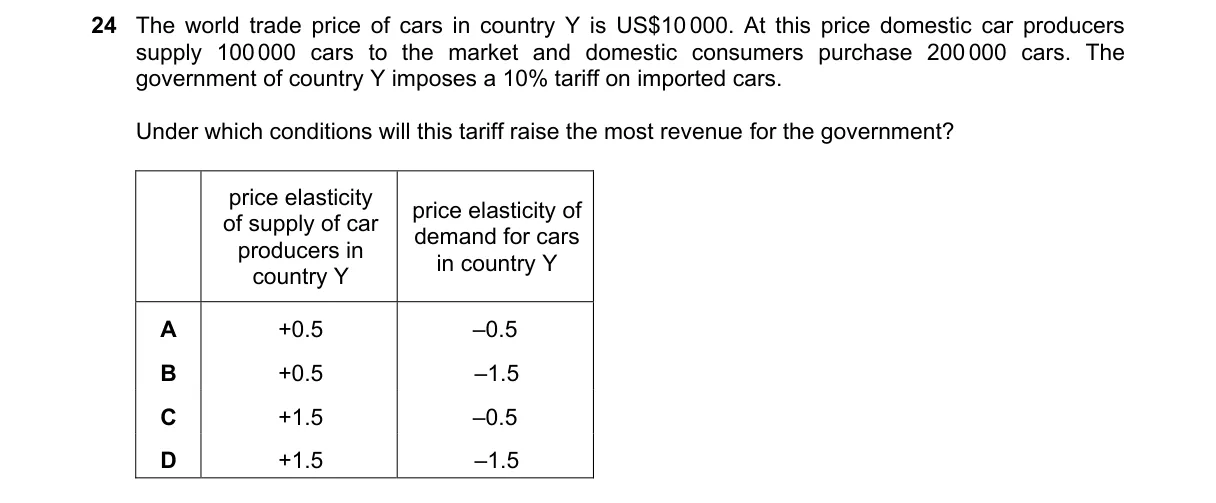
Answer choices
- Aelasticity of supply +0.5, price elasticity of demand -0.5
- Belasticity of supply -0.5, price elasticity of demand -0.5
- Celasticity of supply +1.5, price elasticity of demand -0.5
- Delasticity of supply +1.5, price elasticity of demand -1.5
Explanation
Tariff revenue maximized with inelastic supply and demand
Steps:
- Domestic price rises to $11,000 with 10% tariff.
- New demand ≈ 200,000 × (1 + Ed × 0.1); new supply ≈ 100,000 × (1 + Es × 0.1).
- New imports = new demand - new supply ≈ 100,000 × [1 - 0.2|Ed| - 0.1|Es|].
- Revenue = $1,000 × new imports; maximized when |Ed| and |Es| are smallest.
Why A is correct:
- Inelastic Es=0.5 and Ed=-0.5 minimize import reduction (to 85,000 cars), maximizing revenue via smallest weighted elasticities sum (0.15).
Why the others are wrong:
- B: Negative Es=-0.5 invalid; supply elasticity must be positive.
- C: Elastic Es=1.5 boosts supply more, cutting imports to 75,000 cars.
- D: Elastic |Ed|=1.5 and Es=1.5 shrink imports most (to 55,000 cars).
Final answer: A
Topic: Protectionism
Practice more A Level Economics (9708) questions on mMCQ.me