A Level Economics (9708)•9708/13/M/J/21
A Level Economics (9708) — 9708/13/M/J/21, Question 14
In many countries there are goods that must be provided directly by the government. What would be the most convincing argument for such provision by the government?
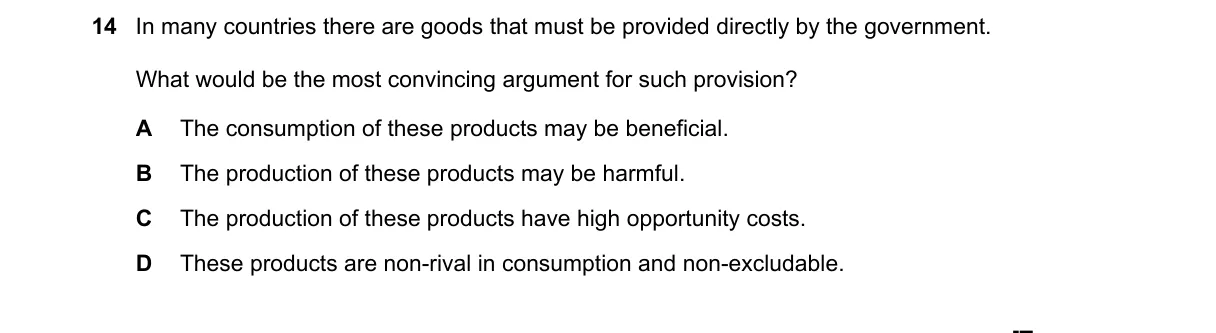
Answer choices
- AThe consumption of these products may be beneficial.
- BThe production of these products may be harmful.
- CThe production of these products have opportunity costs.
- DThese products are non-rival in consumption and non-excludable.
Explanation
Public Goods and Market Failure
Steps:
- Recognize that government direct provision targets market failures where private markets underprovide goods.
- Identify key characteristics: goods that are non-rival (one person's use doesn't reduce availability for others) and non-excludable (hard to prevent non-payers from benefiting).
- Match these traits to option D, as they cause free-rider problems, making private supply inefficient.
- Eliminate other options, as they don't explain why government must provide directly.
Why D is correct:
- Public goods, defined as non-rival and non-excludable, lead to the free-rider problem under the Samuelson condition for efficient provision, requiring government intervention to achieve optimal supply.
Why the others are wrong:
- A: Beneficial consumption (merit goods) can be encouraged via subsidies, not requiring direct government provision.
- B: Harmful production justifies regulation or bans, not government production.
- C: Opportunity costs apply to all goods, not uniquely justifying government provision.
Final answer: D
Topic: Reasons for government intervention in markets
Practice more A Level Economics (9708) questions on mMCQ.me