A Level Economics (9708)•9708/13/M/J/21
A Level Economics (9708) — 9708/13/M/J/21, Question 11
A country’s central bank has commissioned a report on the demand for and price of houses. What might be the most likely combination of reasons for an increase in the price and quantity demanded of houses?
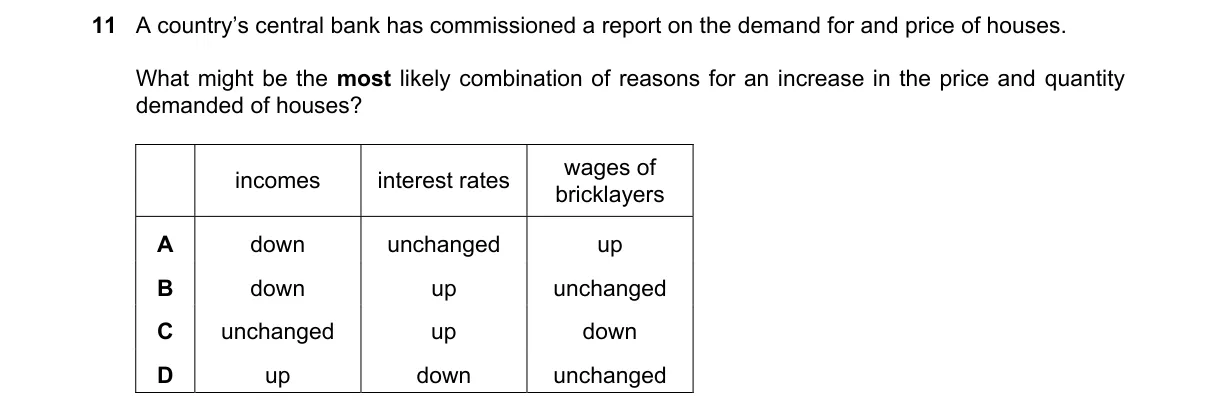
Answer choices
- Aincomes down, interest rates unchanged, wages of bricklayers up
- Bincomes down, interest rates up, wages of bricklayers unchanged
- Cincomes unchanged, interest rates up, wages of bricklayers down
- Dincomes up, interest rates down, wages of bricklayers unchanged
Explanation
Demand Shift for Houses
Steps:
- Identify that rising price and quantity signal a rightward demand shift with stable supply.
- Note demand for houses rises with higher incomes (more buying power) and lower interest rates (affordable mortgages).
- Check supply: unchanged if construction wages stable; leftward if wages rise (higher costs).
- Select option boosting demand without harming supply.
Why D is correct:
- Higher incomes and lower interest rates shift demand right per the law of demand, raising equilibrium price and quantity with unchanged supply.
Why the others are wrong:
- A: Falling incomes shift demand left (lowers quantity); rising wages shift supply left (raises price), but quantity falls overall.
- B: Falling incomes and rising rates both shift demand left, lowering price and quantity.
- C: Rising rates shift demand left; falling wages shift supply right, lowering price (quantity may rise, but price falls).
Final answer: D
Topic: The interaction of demand and supply
Practice more A Level Economics (9708) questions on mMCQ.me