A Level Economics (9708)•9708/12/M/J/21
A Level Economics (9708) — 9708/12/M/J/21, Question 6
The price elasticity of demand for a product is equal to one for all price changes. What would be the result?
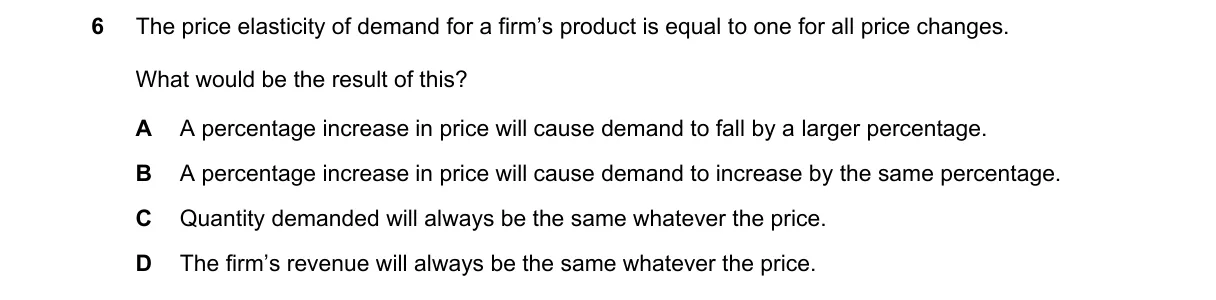
Answer choices
- AA percentage increase in price will cause demand to fall by a larger percentage.
- BA percentage increase in price will cause demand to fall by the same percentage.
- CQuantity demanded will be the same whatever the price.
- DThe firm's revenue will be the same whatever the price.
Explanation
Unitary Price Elasticity Implies Constant Total Revenue
Steps:
- Recall price elasticity of demand (E_d) measures percentage change in quantity demanded divided by percentage change in price.
- Unitary elasticity means |E_d| = 1, so a 1% price increase causes a 1% quantity decrease (and vice versa).
- Total revenue (TR) = price (P) × quantity (Q); percentage change in TR ≈ %ΔP + %ΔQ.
- With |E_d| = 1, %ΔQ = -%ΔP, so %ΔTR = %ΔP - %ΔP = 0, keeping TR constant.
Why D is correct:
- For unitary elasticity, the formula TR = P × Q shows offsetting percentage changes in P and Q, maintaining constant revenue regardless of price.
Why the others are wrong:
- A describes elastic demand where |E_d| > 1, causing larger quantity drop than price rise.
- B restates the elasticity definition but misses the revenue implication as the key result.
- C describes perfectly inelastic demand where E_d = 0 and quantity is unchanged by price.
Final answer: D
Topic: Price elasticity, income elasticity and cross elasticity of demand
Practice more A Level Economics (9708) questions on mMCQ.me