A Level Economics (9708)•9708/12/M/J/21
A Level Economics (9708) — 9708/12/M/J/21, Question 27
Increased international competition leads to a worsening in a country's current account balance. In the absence of any offsetting factors, how is this likely to affect the exchange rate and domestic cost-push inflation?
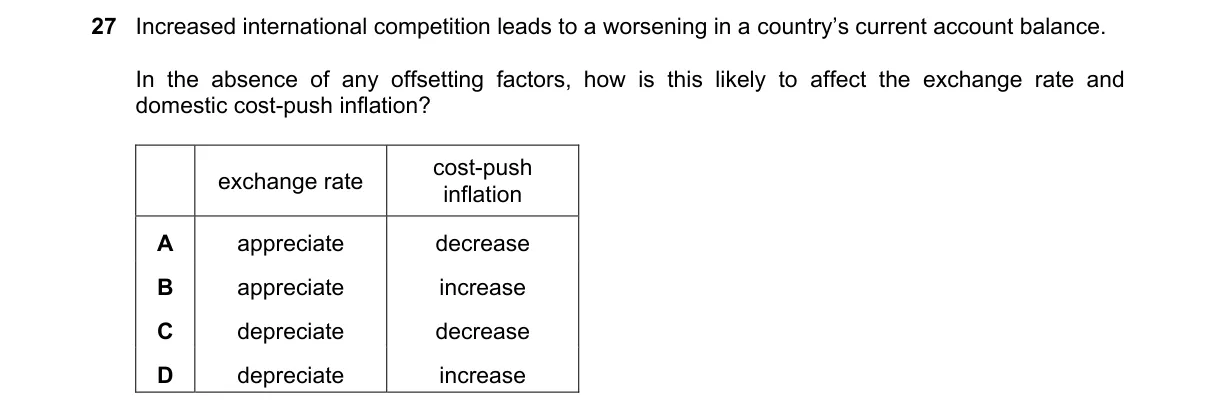
Answer choices
- Aappreciate decrease
- Bdepreciate increase
- Cdepreciate decrease
- Ddepreciate increase
Explanation
Current Account Deficit Drives Currency Depreciation and Cost-Push Inflation
Steps:
- Increased international competition boosts imports or cuts exports, worsening the current account balance into a larger deficit.
- A current account deficit increases supply of domestic currency in forex markets, causing depreciation.
- Currency depreciation raises the price of imported goods and inputs.
- Higher import costs push up production expenses, leading to cost-push inflation.
Why D is correct:
- Per balance of payments theory, a current account deficit depreciates the exchange rate, increasing import prices and thus cost-push inflation via the pass-through effect.
Why the others are wrong:
- A: Appreciation contradicts deficit-induced depreciation; decrease ignores rising import costs.
- B: Depreciation correct but identical to D—likely a duplicate; increase aligns but not uniquely D.
- C: Depreciation correct, but decrease wrong as inflation rises from cost pressures.
Final answer: D
Topic: Exchange rates
Practice more A Level Economics (9708) questions on mMCQ.me