A Level Economics (9708)•9708/11/M/J/21
A Level Economics (9708) — 9708/11/M/J/21, Question 29
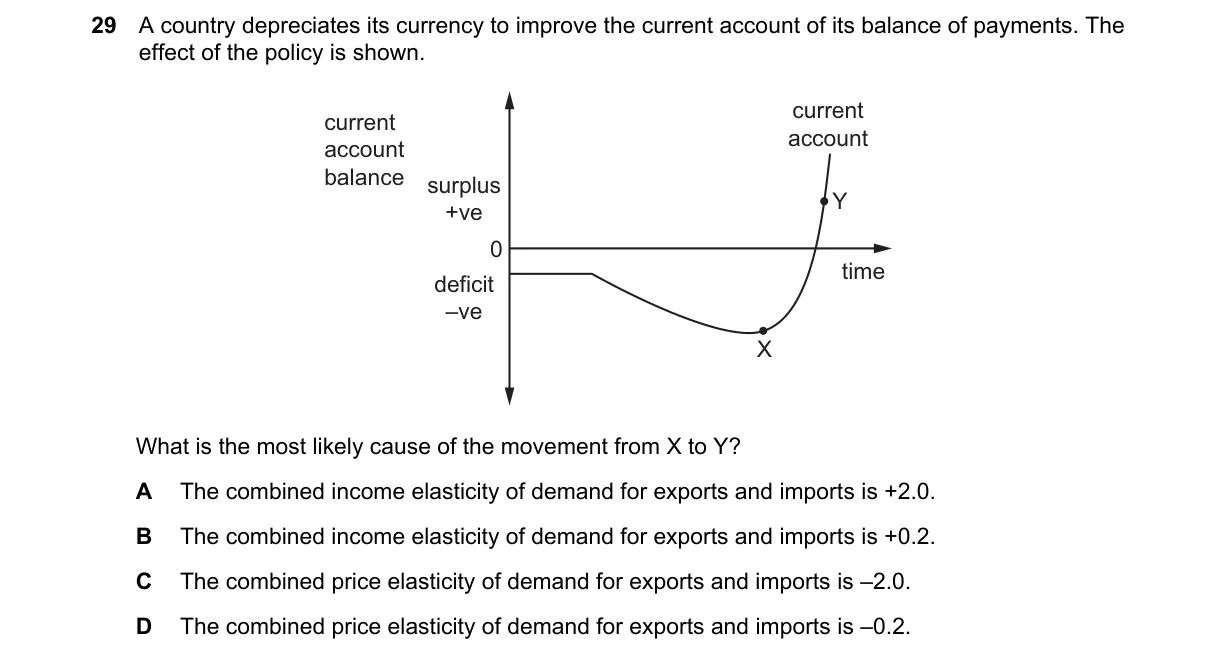
A country depreciates its currency to improve the current account of its balance of payments. The effect of the policy is shown. [graph with current balance from deficit to surplus over time, movement from X to Y] What is the most likely cause of the movement from X to Y?
Answer choices
- AThe combined income elasticity of demand for exports and imports is 2.0.
- BThe combined price elasticity of demand for exports and imports is 2.0.
- CThe combined price elasticity of demand for exports and imports is 0.2.
- DThe combined income elasticity of demand for exports and imports is 0.2.
Explanation
J-Curve Effect from Low Price Elasticities
Steps:
- Currency depreciation raises import prices and lowers export prices in domestic terms.
- If price elasticities are low (inelastic demand), import volumes fall little but values rise, while export volumes rise little, worsening the current account initially (X as deeper deficit).
- Over time, quantities adjust as consumers switch, leading to net improvement (Y as surplus).
- Low combined price elasticity (<1) explains the delayed positive shift shown over time.
Why C is correct:
- Marshall-Lerner condition requires sum of price elasticities >1 for improvement; 0.2 (<1) causes short-run worsening then long-run gain via J-curve.
Why the others are wrong:
- A: Income elasticity affects trade response to GDP changes, not price effects of depreciation.
- B: Elasticity of 2.0 (>1) would cause immediate surplus, not delayed movement over time.
- D: Income elasticity of 0.2 is irrelevant to depreciation's price mechanism.
Final answer: C
Topic: Policies to correct imbalances in the current account of the balance of payments
Practice more A Level Economics (9708) questions on mMCQ.me