A Level Economics (9708)•9708/11/M/J/21
A Level Economics (9708) — 9708/11/M/J/21, Question 22
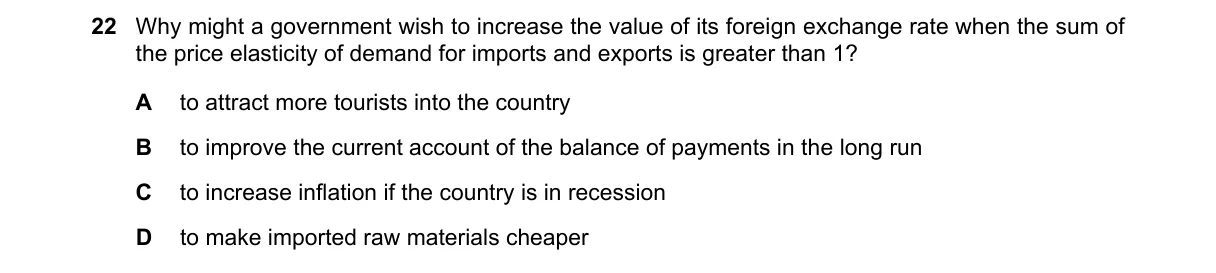
Why might a government wish to increase the value of the foreign exchange rate when the sum of the price elasticity of demand for imports and exports is greater than 1?
Answer choices
- Ato attract more tourists into the country
- Bto increase inflation if the country is in recession
- Cto improve the current account of the balance of payments in the long run
- Dto make imported raw materials cheaper
Explanation
Currency Appreciation and Import Costs
Steps:
- Increasing the foreign exchange rate appreciates the domestic currency.
- Appreciation raises export prices abroad but lowers import prices domestically.
- When import + export demand elasticities sum >1 (Marshall-Lerner condition), appreciation worsens the trade balance long-term.
- Governments may still appreciate to cut costs for import-dependent industries.
Why D is correct:
- Currency appreciation reduces the domestic cost of foreign goods via the exchange rate mechanism, making imported raw materials cheaper for producers.
Why the others are wrong:
- A: Appreciation increases costs for foreign tourists, reducing inflows.
- B: Cheaper imports exert downward pressure on prices, curbing inflation.
- C: Marshall-Lerner condition (>1 sum) implies appreciation deteriorates the current account.
Final answer: D
Topic: Exchange rates
Practice more A Level Economics (9708) questions on mMCQ.me