A Level Economics (9708)•9708/11/M/J/21
A Level Economics (9708) — 9708/11/M/J/21, Question 12
The price elasticity of supply of a good is elastic. Assuming all production costs are constant, which combination correctly describes the link between the impact of a rise in price on the quantity supplied and the total revenue received by the firm?
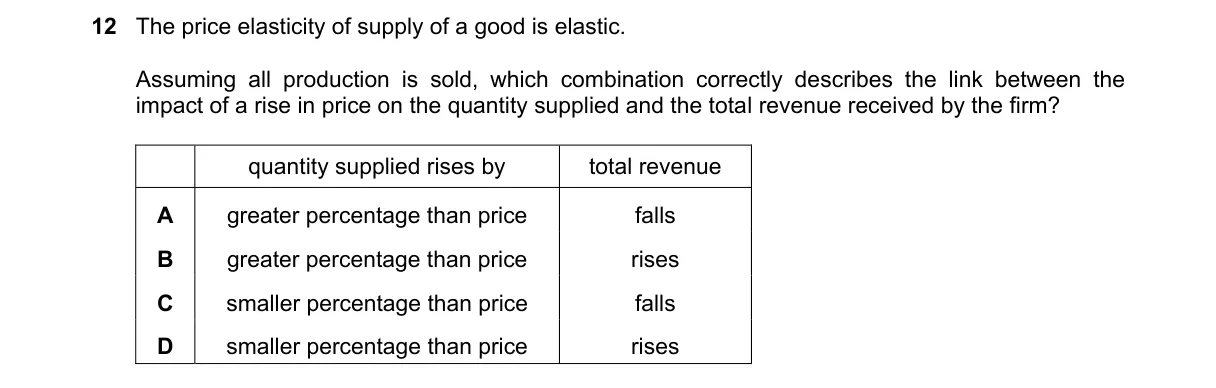
Answer choices
- Aquantity supplied rises by greater percentage than price total revenue rises
- Bquantity supplied rises by greater percentage than price total revenue falls
- Cquantity supplied rises by smaller percentage than price total revenue rises
- Dquantity supplied rises by smaller percentage than price total revenue falls
Explanation
Elastic Supply Increases Total Revenue More Than Proportionally
Steps:
- Elastic supply means percentage increase in quantity supplied exceeds percentage increase in price (|Es| > 1).
- Total revenue (TR) = price × quantity supplied.
- For a price rise, quantity supplied rises by a larger percentage, so TR rises because the gain from higher quantity outweighs any proportional effect.
- Constant production costs affect profit but not TR calculation.
Why A is correct:
- With elastic supply, %ΔQs > %ΔP, so %ΔTR ≈ %ΔP + %ΔQs > 0 and amplified, causing TR to rise per the TR elasticity formula (1 + Es > 2).
Why the others are wrong:
- B: TR rises, not falls, as both P and Qs increase.
- C: Describes inelastic supply (%ΔQs < %ΔP), but question specifies elastic.
- D: Incorrectly states inelastic response and TR fall, but TR always rises for price increases along upward-sloping supply.
Final answer: A
Topic: Price elasticity of supply
Practice more A Level Economics (9708) questions on mMCQ.me