A Level Economics (9708)•9708/13/M/J/20
A Level Economics (9708) — 9708/13/M/J/20, Question 20
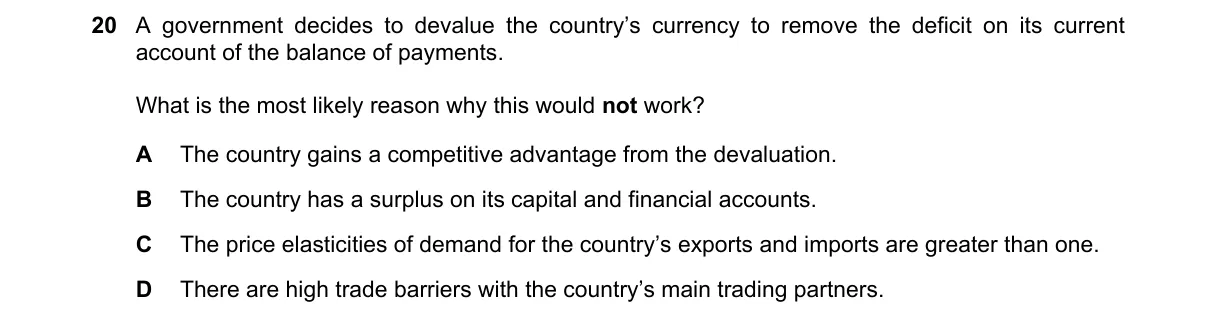
A government decides to devalue the country's currency to remove the deficit on its current account balance of payments. What is the most likely reason why
Answer choices
- AThe country gains a competitive advantage from the devaluation.
- BThe country has a surplus on capital and financial accounts.
- CThe price elasticities of demand for the country's exports and imports are greater than one.
- DThere are high barriers with the country's main trading partners.
Explanation
Currency Devaluation Improves Trade Competitiveness
Steps:
- Devaluation lowers the currency's value, making exports cheaper for foreign buyers and imports more expensive domestically.
- This shifts demand toward domestic goods, boosting exports and curbing imports.
- The net effect reduces the current account deficit if export revenues rise more than import costs.
- Competitive pricing is the primary mechanism driving this adjustment in international trade.
Why A is correct:
- Devaluation directly enhances export competitiveness by reducing prices in foreign markets, increasing net exports per the balance of payments identity (current account = exports - imports).
Why the others are wrong:
- B: Capital/financial surpluses offset overall BOP imbalances but do not address current account deficits directly.
- C: Elasticities >1 (Marshall-Lerner condition) ensure devaluation works but is a prerequisite, not the core reason for choosing it.
- D: High barriers (e.g., tariffs) hinder trade flows and reduce devaluation's effectiveness, providing no incentive to devalue.
Final answer: A
Topic: Policies to correct imbalances in the current account of the balance of payments
Practice more A Level Economics (9708) questions on mMCQ.me